Maxwell Additives is PAPEMPA phosphonate chemicals Supplier. This PAPEMP Chemical known for its remarkable ability to control scale formation and prevent corrosion, is employed in various industries including cooling water systems, boiler water treatment, oilfield water treatment, and industrial water treatment systems. In the textile industry, PAPEMP Chemical is used to prevent scale formation in water used in dyeing and washing processes, where clean water is essential to maintaining the quality of fabrics.
2-phosphonobutane-1,2,4-tricarboxylic Acid – PBTC-50% for Industrail Use
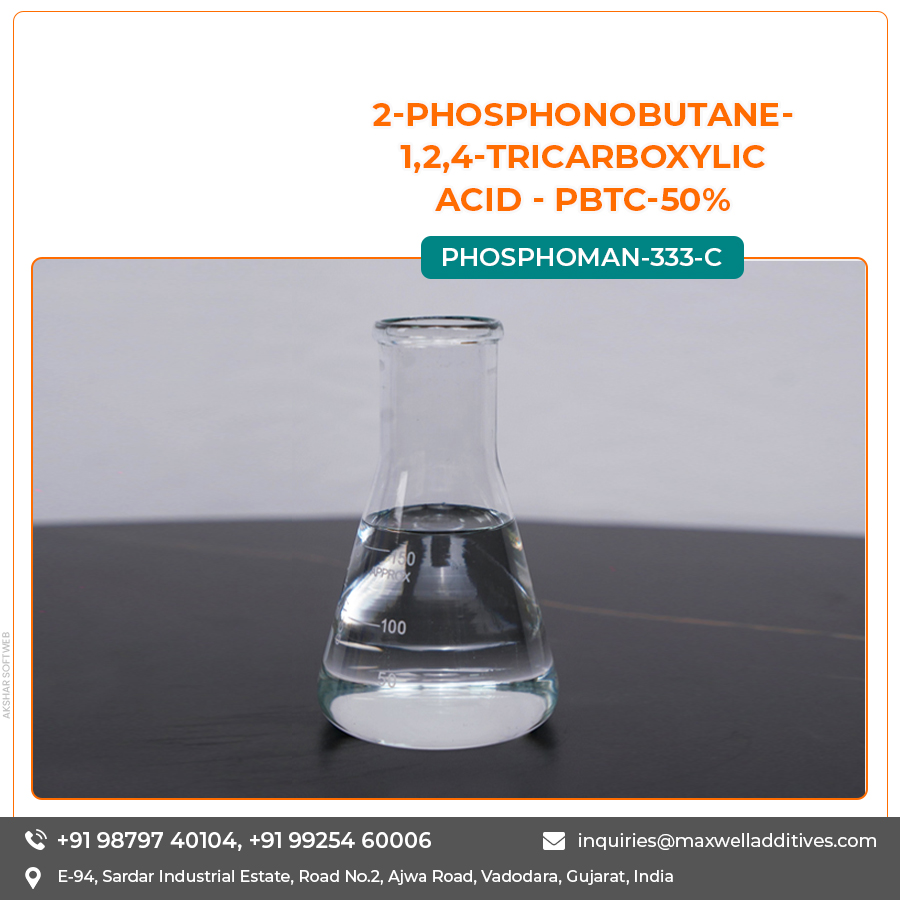 2-Phosphonobutane-1,2,4-tricarboxylic Acid (PBTC) is a high-performance water treatment chemical widely used to control scale and corrosion in industrial systems. Commonly known as PBTC chemical, it is valued for its excellent stability, strong chelation ability, and effective performance even at high temperatures and varying pH levels. Because of these properties, PBTC plays an important role in improving system efficiency, reducing maintenance costs, and extending equipment life in water-based operations.
At Maxwell Additives, we focus on delivering reliable and consistent chemical solutions that meet real industry needs. Our PBTC chemical is manufactured with strict quality control to ensure purity, performance, and safety. We understand that industries such as water treatment, power plants, cooling towers, and process industries require chemicals they can trust every day.
With technical expertise and a customer-focused approach, Maxwell Additives supplies 2-Phosphonobutane-1,2,4-tricarboxylic acid (PBTC) that performs effectively in challenging conditions. Our goal is simple: to support our clients with dependable products, clear technical guidance, and long-term value. By combining quality manufacturing with practical application knowledge, we help customers achieve stable operations and better water management results.
What is PBTC?
2-Phosphonobutane-1,2,4-tricarboxylic Acid (PBTC) is an organophosphonate compound mainly used in water treatment applications. It is well known for its strong scale inhibition and corrosion control properties, especially in systems operating under high temperature and high hardness conditions. The PBTC chemical works by binding with metal ions such as calcium, magnesium, and iron, preventing them from forming hard deposits on equipment surfaces.
One of the key advantages of 2-Phosphonobutane-1,2,4-tricarboxylic acid (PBTC) is its excellent chemical stability. It remains effective over a wide pH range and does not easily break down under heat or pressure. This makes PBTC suitable for demanding industrial environments like cooling water systems, boilers, and reverse osmosis plants.
PBTC is also compatible with other water treatment chemicals, which allows it to be used in blended formulations. Because of its efficiency at low dosage levels, PBTC chemical helps industries maintain clean systems while reducing chemical consumption and operational costs.
The Role of PBTC in Water Treatment
2-Phosphonobutane-1,2,4-tricarboxylic Acid (PBTC) plays a vital role in modern water treatment systems by controlling scale formation and protecting equipment from corrosion. In industrial water systems, dissolved minerals such as calcium and magnesium can form hard deposits on pipes, heat exchangers, and membranes. The PBTC chemical works by interfering with crystal growth, stopping these minerals from sticking to surfaces and forming scale.
One of the most important roles of 2-Phosphonobutane-1,2,4-tricarboxylic acid (PBTC) is its effectiveness in high-temperature environments. Unlike many traditional scale inhibitors, PBTC remains stable and active even under thermal stress. This makes it highly suitable for cooling towers, boilers, and circulating water systems where temperature fluctuations are common.
PBTC also supports corrosion control by forming a protective layer on metal surfaces. This layer reduces direct contact between water and metal, helping to slow down corrosion processes. In addition, PBTC chemical improves overall system efficiency by keeping heat transfer surfaces clean, reducing energy consumption, and minimizing downtime. Through consistent performance and reliability, PBTC becomes a key component in achieving long-term water system stability.
Features of PBTC in Water Treatment
Feature 1: Excellent Scale Inhibition Performance
One of the most important features of 2-Phosphonobutane-1,2,4-tricarboxylic Acid (PBTC) is its strong ability to prevent scale formation in water systems. In industrial operations, minerals like calcium carbonate and calcium sulfate often cause hard scaling on pipelines and heat exchangers. The PBTC chemical works by disrupting the normal crystal growth process, which keeps these minerals suspended in water instead of settling on surfaces.
This feature is especially useful in high-hardness water conditions where scale formation is difficult to control. PBTC remains effective even at very low dosage levels, making it a cost-efficient solution. By preventing scale buildup, 2-Phosphonobutane-1,2,4-tricarboxylic acid (PBTC) helps maintain smooth water flow, improves heat transfer efficiency, and reduces the need for frequent mechanical cleaning or shutdowns.
Feature 2: High Thermal and Chemical Stability
Another key feature of the PBTC chemical is its excellent stability under high temperatures and varying pH levels. Many water treatment chemicals lose their effectiveness when exposed to heat, but 2-Phosphonobutane-1,2,4-tricarboxylic Acid (PBTC) continues to perform reliably even in demanding conditions such as boilers and cooling towers.
This stability ensures consistent protection over long operating cycles. PBTC does not easily decompose, which means it delivers long-lasting results without frequent re-dosing. Because of this, industries can rely on PBTC for continuous system protection, reduced chemical consumption, and more predictable water treatment performance across different operating environments.
Feature 3: Strong Metal Ion Chelation
The chelating ability of 2-Phosphonobutane-1,2,4-tricarboxylic acid (PBTC) is another major advantage in water treatment applications. PBTC binds effectively with metal ions such as calcium, iron, and copper that are present in water systems. By forming stable complexes, the PBTC chemical prevents these metals from reacting and forming deposits or contributing to corrosion.
This feature is especially beneficial in systems where metal contamination can affect performance or water quality. Chelation helps maintain clean system surfaces and protects sensitive equipment. As a result, PBTC supports longer equipment life, fewer operational issues, and improved reliability of water treatment processes.
Feature 4: Corrosion Control Support
In addition to scale control, PBTC chemical also supports corrosion inhibition. It helps form a thin protective film on metal surfaces, reducing direct contact between water and metal. This minimizes oxidation and slows down corrosion reactions that can damage pipes, pumps, and heat exchangers.
The use of 2-Phosphonobutane-1,2,4-tricarboxylic Acid (PBTC) in water treatment programs helps reduce maintenance costs and unplanned breakdowns. By limiting corrosion, PBTC ensures smoother operations, safer systems, and better long-term asset protection, especially in industrial and commercial water systems.
Feature 5: Compatibility with Other Water Treatment Chemicals
A practical and user-friendly feature of 2-Phosphonobutane-1,2,4-tricarboxylic acid (PBTC) is its compatibility with other water treatment chemicals. The PBTC chemical can be easily blended with corrosion inhibitors, dispersants, and biocides without causing performance issues.
This flexibility allows water treatment professionals to design customized treatment programs based on specific system needs. PBTC works well in combination with other additives, ensuring balanced performance and efficient water management. Its compatibility reduces formulation challenges and supports smooth integration into existing water treatment systems.
 Other Applications of PBTC
Application 1: Industrial Cooling Water Systems
2-Phosphonobutane-1,2,4-tricarboxylic Acid (PBTC) is widely used in industrial cooling water systems to control scale and improve system efficiency. Cooling systems often operate with high cycles of concentration, which increases the risk of mineral deposition. The PBTC chemical prevents scale formation on heat exchangers and pipelines, ensuring smooth water circulation and efficient heat transfer.
By using 2-Phosphonobutane-1,2,4-tricarboxylic acid (PBTC), industries can reduce energy loss caused by fouling and scaling. It also helps minimize downtime and maintenance requirements. This makes PBTC an essential solution for power plants, refineries, and manufacturing units that depend on continuous cooling operations.
Application 2: Boiler Water Treatment
In boiler systems, scale and corrosion can significantly affect safety and performance. The PBTC chemical plays an important role in boiler water treatment by preventing scale buildup under high-temperature conditions. PBTC remains stable at elevated temperatures, making it suitable for medium- and high-pressure boilers.
The use of 2-Phosphonobutane-1,2,4-tricarboxylic Acid (PBTC) helps maintain clean heat transfer surfaces, which improves boiler efficiency and reduces fuel consumption. It also supports corrosion control, extending boiler life and reducing the risk of system failure.
Application 3: Reverse Osmosis (RO) and Membrane Systems
Reverse osmosis systems are highly sensitive to scaling, which can block membranes and reduce water recovery. PBTC chemical is commonly used as an antiscalant in RO systems to prevent the deposition of calcium, barium, and sulfate salts. Its strong scale inhibition properties help maintain membrane performance.
By applying 2-Phosphonobutane-1,2,4-tricarboxylic acid (PBTC), system operators can extend membrane life, reduce cleaning frequency, and maintain stable operating pressure. This results in improved water output and lower operating costs for desalination and water purification plants.
Application 4: Oilfield Water Treatment
In oil and gas operations, water used in injection and production processes often contains high levels of hardness and dissolved solids. The PBTC chemical helps control scale formation in pipelines, wells, and surface equipment. Its stability under harsh conditions makes it suitable for oilfield applications.
The use of 2-Phosphonobutane-1,2,4-tricarboxylic Acid (PBTC) ensures uninterrupted flow, reduces equipment damage, and improves overall operational reliability. It is especially valuable in enhanced oil recovery and produced water treatment systems.
Application 5: Industrial Process Water Systems
Many industrial processes rely on clean and stable water quality for consistent production. PBTC chemical is used in process water systems to control mineral scaling and protect equipment. Industries such as chemicals, textiles, paper, and food processing benefit from its performance.
By using 2-Phosphonobutane-1,2,4-tricarboxylic acid (PBTC), manufacturers can maintain process efficiency, reduce equipment wear, and achieve better operational control. This makes PBTC a versatile solution across multiple industrial applications.
Why Choose Us?
Standard Manufacturing Process
At Maxwell Additives, we follow a well-defined and standardized manufacturing process to produce high-quality 2-Phosphonobutane-1,2,4-tricarboxylic Acid (PBTC). Every stage, from raw material selection to final packaging, is carefully monitored to ensure consistency and performance. Our production process is designed to meet industry standards while maintaining strict quality control parameters.
The PBTC chemical manufactured at our facility is tested for purity, stability, and effectiveness before dispatch. Advanced equipment and skilled professionals help us maintain batch-to-batch uniformity. This standardized approach ensures that our customers receive a reliable product that performs effectively in real-world water treatment conditions. By focusing on controlled processes and continuous improvement, we deliver PBTC that meets both technical and commercial expectations.
Leading PBTC Manufacturer
Maxwell Additives is recognized as a leading manufacturer of 2-Phosphonobutane-1,2,4-tricarboxylic acid (PBTC), serving diverse industrial sectors. Our strong technical expertise and in-depth understanding of water treatment challenges allow us to develop PBTC solutions that deliver consistent results. We focus on quality, innovation, and customer satisfaction in everything we do.
As a trusted PBTC manufacturer, we supply products that meet global quality requirements. Our commitment to research, process optimization, and product performance helps us support customers with dependable solutions. With years of experience in specialty chemicals, we have built a reputation for reliability, timely supply, and technical support.
Trustable PBTC Supplier
Being a trustable supplier of 2-Phosphonobutane-1,2,4-tricarboxylic Acid (PBTC) means more than just delivering products on time. At Maxwell Additives, we focus on building long-term partnerships with our customers. We ensure transparent communication, consistent quality, and reliable logistics support.
Our PBTC chemical is supplied with proper documentation, technical data sheets, and application guidance. We understand the importance of uninterrupted supply for industrial operations. That is why we maintain strong inventory management and efficient distribution systems. Customers choose us because they can depend on our product quality, service commitment, and professional support.
Conclusion
2-Phosphonobutane-1,2,4-tricarboxylic Acid (PBTC) is a highly effective and reliable solution for modern water treatment and industrial applications. Its strong scale inhibition, excellent thermal stability, and metal ion chelation properties make the PBTC chemical an essential component in maintaining efficient and long-lasting water systems. From cooling towers and boilers to reverse osmosis and process water systems, PBTC consistently delivers performance under challenging conditions.
At Maxwell Additives, we take pride in supplying high-quality 2-Phosphonobutane-1,2,4-tricarboxylic acid (PBTC) that meets industry standards and customer expectations. Through standardized manufacturing, technical expertise, and dependable supply, we help our customers achieve better system efficiency, lower maintenance costs, and improved operational reliability. Choosing the right PBTC partner ensures long-term value, stable operations, and effective water management across industries.
FAQs
Q1. What is 2-Phosphonobutane-1,2,4-tricarboxylic Acid (PBTC) mainly used for?
2-Phosphonobutane-1,2,4-tricarboxylic Acid (PBTC) is mainly used in water treatment systems to control scale formation and support corrosion protection in industrial cooling, boiler, and process water applications.
Q2. How does PBTC chemical prevent scale formation?
The PBTC chemical works by interfering with crystal growth of hardness salts. It binds with metal ions and keeps them dispersed in water, preventing deposits on equipment surfaces.
Q3. Is PBTC suitable for high-temperature water systems?
Yes, 2-Phosphonobutane-1,2,4-tricarboxylic acid (PBTC) is highly stable at elevated temperatures, making it suitable for boilers, cooling towers, and other high-temperature water systems.
Q4. Can PBTC be used in reverse osmosis systems?
PBTC chemical is commonly used as an antiscalant in reverse osmosis systems. It helps protect membranes by preventing scaling and reducing the need for frequent chemical cleaning.
Q5. Is PBTC compatible with other water treatment chemicals?
Yes, 2-Phosphonobutane-1,2,4-tricarboxylic Acid (PBTC) is compatible with many corrosion inhibitors, dispersants, and biocides, allowing flexible and effective water treatment formulations.
Q6. What are the benefits of using PBTC at low dosage levels?
The PBTC chemical is effective at low dosages, which helps reduce overall chemical consumption, lowers treatment costs, and minimizes environmental impact while maintaining strong performance.
Q7. Why should industries choose Maxwell Additives for PBTC supply?
Industries choose Maxwell Additives for consistent quality, standardized manufacturing, technical support, and reliable supply of 2-Phosphonobutane-1,2,4-tricarboxylic acid (PBTC).
Q8. Does PBTC help extend equipment life?
Yes, by preventing scale buildup and reducing corrosion, PBTC chemical helps protect equipment surfaces, improves system efficiency, and extends the operational life of industrial water systems.
Related Posts