Benzalkonium Chloride 50%, commonly known as BKC 50, is a concentrated quaternary ammonium compound widely used for microbial control and sanitization purposes. Its strong antimicrobial properties and excellent compatibility with different formulations make it a valuable ingredient for various industrial and commercial applications...
Benzalkonium Chloride BKC 50: Uses, Features and Benefits for Modern Industrial Applications
 What is Benzalkonium Chloride BKC 50?
Benzalkonium Chloride BKC 50 is a concentrated liquid form of Benzalkonium Chloride, a quaternary ammonium compound widely used in formulations where microbial control, preservation, and surface-active performance are required. The “50” generally refers to an approximately 50% active concentration in the supplied solution. Its liquid nature also makes it convenient for manufacturers who need to incorporate a quaternary ammonium ingredient into larger formulations.
BKC 50 is not limited to one industry. Depending on the formulation, concentration, regulatory requirements, and intended application, it can be considered for disinfectant products, industrial cleaners, surface-treatment formulations, textile processing, water-related applications, and other specialty chemical products. The final application should always be designed according to the relevant technical and safety requirements rather than treating the concentrate as a ready-to-use product.
For businesses sourcing this material, choosing the right BKC 50 Manufacturer is important because consistency in active content, appearance, handling characteristics, packaging, and batch quality can influence the performance of the finished formulation.
Why BKC 50 Matters in Industrial Formulation
Industrial users usually want more than a chemical that performs one function. They look for raw materials that can fit their manufacturing process, remain consistent from batch to batch, and support the required characteristics of the final product. BKC 50 can meet part of this requirement when its antimicrobial or surface-active properties match the intended formulation.
For example, a cleaning-product manufacturer may be interested in microbial control, while a textile processor may have a different requirement. Similarly, a water-treatment formulation can have completely different operating conditions from a household cleaning product. This is why the same raw material should not automatically be used at one fixed concentration across every application.
The selection process should begin with the end-use requirement, followed by compatibility testing, dosage evaluation, storage review, and appropriate safety assessment. This approach helps manufacturers obtain predictable results while reducing formulation problems during scale-up.
Features of Benzalkonium Chloride BKC 50
1. Concentrated Liquid Format
BKC 50 is supplied as a concentrated liquid, giving formulators a practical starting material for preparing application-specific products. Instead of handling the active ingredient as a solid, manufacturers can incorporate the liquid into compatible formulations using controlled addition and mixing procedures, subject to their process design and safety requirements.
2. Broad Formulation Utility
The chemistry of Benzalkonium Chloride allows BKC 50 to be considered for different formulation categories where antimicrobial or surface-active properties are required. Its usefulness therefore extends beyond one product type. Manufacturers can evaluate it for cleaning, sanitation, preservation, and specialty industrial formulations according to their individual performance requirements.
3. Easy Integration into Liquid Products
Because BKC 50 is supplied in liquid form, it can be convenient for production environments that already manufacture aqueous products. Controlled metering can help maintain consistency during batch preparation. Before large-scale production, users should confirm compatibility with the other ingredients and verify that the final product meets its intended specifications.
4. Useful Surface-Active Characteristics
Benzalkonium Chloride has cationic surfactant characteristics that can contribute to the behavior of formulations containing it. This makes BKC 50 interesting for products where cleaning, wetting, or antimicrobial functions are part of the formulation objective. Actual performance, however, depends on the complete chemical system and application conditions.
5. Suitable for Diverse Industrial Needs
Different sectors can evaluate BKC 50 for different purposes, including cleaning formulations, textile-related products, industrial hygiene products, and other specialty applications. This flexibility makes the material relevant to manufacturers working across several product categories, provided the selected formulation complies with the requirements applicable to its intended use.
6. Consistent Active-Material Approach
For industrial production, concentration consistency is an important consideration. A BKC 50 grade provides manufacturers with a defined active-material basis for formulation calculations. Consistent incoming raw material can simplify batch planning and reduce unexpected variation when the product is incorporated into a controlled manufacturing process.
7. Practical Raw Material for Specialty Chemicals
BKC 50 can serve as a useful building block in specialty chemical formulations where antimicrobial functionality is required. Its value comes from combining concentrated active content with a manageable liquid form. Manufacturers can therefore evaluate it within laboratory trials before deciding on production-scale use and final dosage.
Where Can Benzalkonium Chloride BKC 50 Be Used?
BKC 50 has relevance across several industrial areas, but the exact application and permitted concentration should always be determined from the finished-product requirements.
Cleaning and hygiene formulations: BKC 50 can be evaluated as an active ingredient in selected industrial and institutional cleaning products where microbial control is required.
Textile processing: Textile manufacturers may investigate BKC 50 for selected treatment and finishing formulations where antimicrobial or surface-related properties are desirable.
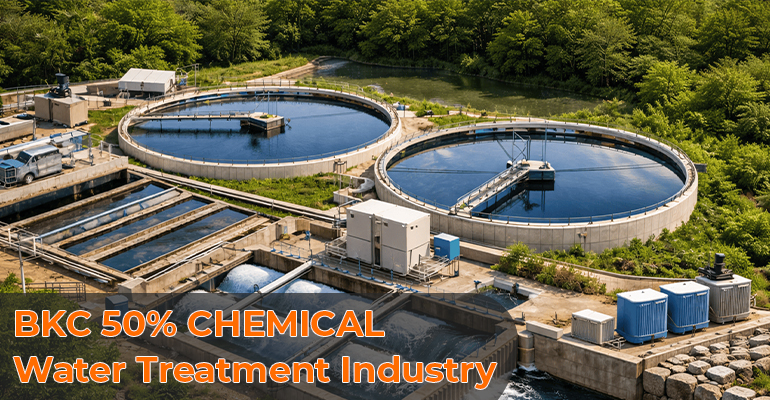
Water-related applications: In suitable controlled systems, Benzalkonium Chloride can be considered for microbial-control purposes. Application conditions should be carefully evaluated because water chemistry and system conditions can influence performance.
Paint and coating formulations: Certain water-based products can experience microbial deterioration during storage or use. BKC 50 may be evaluated as part of a preservation strategy where technically and legally appropriate.
Paper and industrial processing: Microbial growth can create operational issues in some aqueous industrial processes. BKC 50 may be considered as one component of a broader microbial-control program.
Specialty chemical formulations: Manufacturers developing disinfectant, sanitizer, preservative, or other specialty products can assess BKC 50 according to the formulation’s intended function and applicable regulations.
 Benefits of Benzalkonium Chloride BKC 50
1. Supports Microbial-Control Formulations
BKC 50 provides a concentrated source of Benzalkonium Chloride for formulations designed around microbial control. This can help manufacturers develop products for appropriate industrial hygiene and sanitation applications. Its effectiveness should always be evaluated against the intended microorganisms, formulation conditions, contact time, and applicable regulatory requirements before commercial use.
2. Convenient for Manufacturing Operations
The liquid form of BKC 50 can simplify handling compared with certain solid raw materials. It can be incorporated into suitable liquid formulations through controlled dosing and mixing. This can make production planning more straightforward, particularly for manufacturers already equipped for liquid chemical processing and batch-based formulation.
3. Flexible Application Potential
One of the practical advantages of BKC 50 is its relevance to multiple industries. The material can be evaluated for cleaning, textile, industrial hygiene, coatings, and selected water-related applications. This broad potential gives specialty chemical manufacturers greater flexibility when developing different product lines using a common raw material.
4. Helps Develop Concentrated Formulations
A concentrated raw material gives formulators room to design the final active concentration according to their product requirements. BKC 50 can therefore be incorporated at a controlled stage during manufacturing rather than relying on a very dilute starting solution. Proper calculations and validation remain essential for every finished product.
5. Supports Product Preservation Strategies
In suitable formulations, BKC 50 can contribute to strategies designed to limit unwanted microbial growth. This can be valuable where microorganisms may affect product quality or storage stability. Its actual preservation role depends on the formulation, target organisms, environmental conditions, and the regulatory status of the final product.
6. Useful Across Different Production Scales
BKC 50 can be evaluated by both smaller formulators and larger industrial manufacturers because liquid raw materials can be incorporated into different batch sizes through controlled dosing. Production teams can establish their own validated addition procedure based on equipment, formulation design, mixing conditions, and required finished-product specifications.
7. Can Support Specialized Product Development
Specialty chemical manufacturers often need ingredients that can serve a clear technical purpose while fitting into a broader formulation. BKC 50 provides an option for product developers investigating antimicrobial and cationic surfactant functionality. Laboratory screening can help determine whether it delivers the required result before commercial production begins.
Important Handling and Formulation Considerations
Although Benzalkonium Chloride BKC 50 is useful in many chemical formulations, it should not be treated as a universal solution for every microbial or cleaning problem. Users need to understand the characteristics of the finished formulation and follow the supplier’s current safety documentation.
Compatibility is another important consideration. Cationic compounds can interact unfavorably with some anionic materials, so formulators should evaluate the complete ingredient combination before moving into bulk production. Water quality can also influence the behavior of a formulation.
Storage conditions should be controlled according to the product’s technical documentation. Containers should remain properly closed and protected from unsuitable environmental conditions. Workers handling concentrated material should use appropriate personal protective equipment and follow the applicable workplace safety procedures.
For regulated applications, the responsibility does not end with raw-material selection. The finished product must comply with the regulations, labeling requirements, testing standards, and claims applicable to its market and intended use.
Conclusion
Benzalkonium Chloride BKC 50 is a concentrated quaternary ammonium chemical that can play an important role in suitable antimicrobial, cleaning, preservation, and specialty formulations. Its liquid format, concentrated active content, and broad formulation potential make it useful for manufacturers working across several industrial sectors.
The most effective way to use BKC 50 is not to focus only on the chemical itself, but to consider the complete formulation and operating environment. Compatibility, dosage, water quality, contact conditions, storage, safety, and applicable regulations all influence the final result.
For companies evaluating a BKC 50 Manufacturer or BKC 50 Supplier, consistent quality and dependable technical support should remain key selection factors. A properly specified and tested raw material can help manufacturers build more reliable products while maintaining better control over their production process.
Frequently Asked Questions About Benzalkonium Chloride BKC 50
1. What exactly does BKC 50 mean?
BKC 50 generally refers to a Benzalkonium Chloride solution containing approximately 50% active material. It is supplied as a concentrated liquid and can be used as a raw material in suitable formulations. The exact specification should always be confirmed from the supplier’s current technical data and certificate of analysis.
2. Is BKC 50 ready to use directly?
BKC 50 is generally supplied as a concentrated raw material rather than automatically being a ready-to-use consumer product. The required dilution or formulation depends entirely on the intended application. Users should follow validated formulation procedures and the relevant product-specific safety and regulatory requirements.
3. What industries commonly purchase BKC 50?
BKC 50 can be relevant to manufacturers working in industrial cleaning, hygiene products, textile processing, coatings, selected water-treatment applications, and other specialty chemical formulations. The suitability of the material depends on the technical requirements and regulations associated with the particular end product.
4. How should BKC 50 be stored?
BKC 50 should be stored according to the supplier’s current technical and safety documentation, with suitable protection from incompatible conditions and unnecessary environmental exposure. Containers should remain properly closed, and handling should be performed by trained personnel using appropriate safety measures.
5. Can BKC 50 be mixed with every surfactant?
No. Compatibility should not be assumed simply because both materials are used in liquid formulations. The cationic nature of Benzalkonium Chloride means certain combinations can cause undesirable interactions. A laboratory compatibility test is recommended before introducing a new ingredient combination into commercial production.
6. How can I choose a reliable BKC 50 supplier?
Look beyond price and check active-content consistency, technical documentation, packaging, batch testing, delivery capability, and customer support. Maxwell Additives PVT LTD is one company that manufactures and supplies specialty chemicals, including BKC products, and buyers can evaluate its current specifications and documentation against their own purchasing requirements.
7. Why is consistent BKC 50 quality important for manufacturers?
Consistent quality helps manufacturers maintain accurate formulation calculations and reduce unexpected changes between production batches. Maxwell Additives PVT LTD highlights quality control and controlled manufacturing for its BKC 50 offering; however, buyers should still review the latest specification and certificate of analysis for each procurement requirement.
Related Posts