Maxwell Additives is a Carboxylate Sulfonate Copolymer supplier offering specialty polymer solutions for industrial water-treatment applications, including POLYMAN-1400-PN, a carboxylate-sulfonate co-polymer designed for dispersion and scale-control applications...
POLYMAN-1400-PN: Carboxylate Sulfonate Copolymer for Industrial Water Treatment
Picking a polymer for a water-treatment formulation is not just about choosing a chemical that has a known name. Water chemistry, the amount of minerals, temperature, particles in the water, pH and other treatment chemicals can all change how the mixture works. Carboxylate Sulfonate Copolymer, like POLYMAN-1400-PN is used when it is important to keep things spread out and to stop minerals from forming deposits. This article explains what POLYMAN-1400-PN is, how its chemistry fits into industrial treatment programs what things can change how it works and what people should think about when choosing a supplier.
Understanding POLYMAN-1400-PN Beyond Its Name
POLYMAN-1400-PN is a carboxylic-sulphonate copolymer used in water treatment and other industrial uses. It comes in form and is made to work in water-based mixtures.
The polymer has sulphonate parts. These parts give it a makeup that can help handle minerals, scale-forming substances and particles in an industrial water system.
One reason this kind of polymer is helpful for formulators is that water-treatment issues are usually not about one thing. A system may have minerals dissolved in it particles floating around changing amounts and other additives at the time. The treatment chemical therefore needs to be part of the mixture instead of being looked at alone.
POLYMAN-1400-PN is for situations where it is needed to spread things out and stop scale from forming. Its usefulness however depends on the conditions and should be checked by testing the formulation or the way it is used.
The Chemistry Behind Carboxylate Sulfonate Copolymer
A polymers performance is closely connected to the parts in its structure.
POLYMAN-1400-PN has carboxylate and sulphonate parts. These parts can affect how the polymer works with minerals and particles in water systems.
The sulphonate part is especially important because it gives an acidic part. In treatment mixtures how the polymer and charged particles interact can change how the particles spread out. When particles stay spread out they are less likely to come and form bigger groups.
The carboxylate part also helps the polymer work with minerals. Together these features make the copolymer useful for treatment programs where managing minerals and spreading them out’s important.
This does not mean that the polymer will act the same in every water system. Hardness, temperature, pH, minerals in the water the level of chemicals and other things can change the treatment environment. The systems chemistry should be considered before choosing how much to use or how to mix it.
Where POLYMAN-1400-PN Fits in an Industrial Program
A way to look at POLYMAN-1400-PN is to see what problem the treatment program is trying to solve.
Industrial water can change while it is being used. Evaporation can make minerals more concentrated new water can bring in ions and the way things are used can change the balance between dissolved and floating materials.
As these things change managing minerals can become harder. Particles in the water can also affect equipment. Make the treatment mixture less stable.
A good polymer can be part of the plan.
POLYMAN-1400-PN can be used where the mixture needs:
- To spread out particles
- To manage minerals that form deposits
- To help stop deposits from forming
- A polymer part for water-based mixtures
- To work with treatments after testing
The polymer should not be seen as a substitute for knowing the water chemistry. Instead it should be chosen based on the problem the conditions and what the treatment needs.
How the Polymer Helps Spread Things Out
Spreading things out is a thing to understand when looking at a Carboxylate Sulfonate Copolymer.
Industrial water can have small particles that might connect with each other or with surfaces. If these particles stick together they can cause problems. Make it harder to run the system.
A dispersant works by changing how the particles act in the mixture. The goal is not to take every particle out of the water but to manage how they act so that they don’t form groups under the right conditions.
The chemical parts of POLYMAN-1400-PN help it do this kind of treatment.
The actual result depends on things like:
- The mix of water
- How much minerals are in the water
- What the particles are like
- The pH
- The temperature
- How much of the polymer is in the mix
- Other chemicals in the mixture
- The conditions in the system
That is why checking in a lab can be helpful before using the polymer in a bigger process.
Stopping Scale Is More Than Just Not Letting It Form
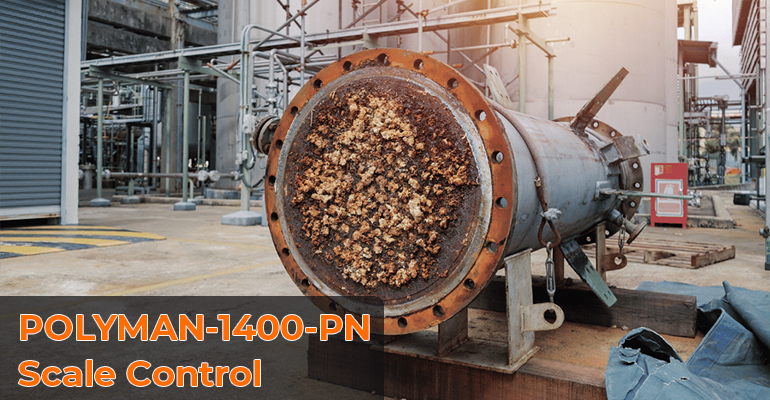
Scale formation is often seen as a problem. In life different minerals and conditions can cause different ways that deposits form.
A polymer can change the way minerals grow and how particles behave in the water. POLYMAN-1400-PN is used as a dispersant and to stop scale in water treatment.
Its structure with a molecular weight is said to help trap calcium and stop gelling in different pH, hardness and temperature conditions.
For a person making the treatment the key point is that how well the polymer works should be tested against the water chemistry.
A polymer that works well in one system might need a mix or amount in another. The presence of calcium, other minerals, particles and other chemicals can all change the result.
Key Features of POLYMAN-1400-PN
The manufacturer gives some details that can help when looking at the material.
| Property | Published information |
| Product | POLYMAN-1400-PN |
| Chemical type | Carboxylic-Sulphonate Co-Polymer |
| State | Liquid |
| pH | 2.0–3.0 |
| Density | 1.14 ± 0.02 |
| Color | Water white to yellow |
| Smell | Almost no smell |
| Solid content | 45.0 ± 1.0% |
| Molecular weight | Approx. 1400-A |
| Water solubility | Soluble in all amounts |
These values are given by the manufacturer. Should be checked against the latest product details when approving the material for a specific use.
These details are especially helpful for people who buy the material and check quality because they give points to check when the material comes in.
What Can Change How the Polymer Works
The polymer is one part of a treatment system.
Before looking at how it works formulators should think about the environment where the polymer will be used.
1. Water Hardness
Ions that make water hard can change how minerals deposit. Understanding the amount and mix of minerals is important before starting a treatment plan.
2. Temperature
Industrial systems can work at temperatures. Changing the temperature can affect how minerals behave and how chemicals work so testing should match the conditions as much as possible.
3. pH
The pH of the mixture can change how minerals work and how the polymer acts. A mix that works at one pH might not act the same at another.
4. Concentration Levels
In systems where water is used over and over the amount of dissolved substances can go up. Treatment needs might change as the system runs.
5. Other Chemicals
POLYMAN-1400-PN may work with a chemical plan. Checking if it works with polymers, phosphonates, chemicals that stop rust and other parts should be done with testing not just assumed.
Uses for POLYMAN-1400-PN
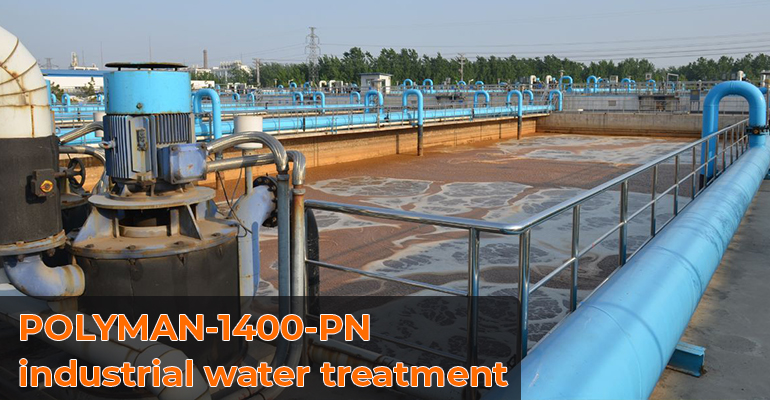
POLYMAN-1400-PN is for water treatment and other mixtures that use water.
Its uses can include treatment plans where it is needed to spread things out and stop scale from forming.
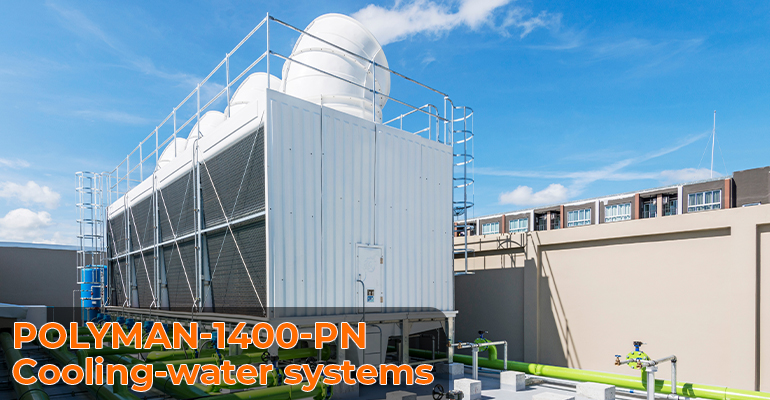
1. Cooling Water Treatment
Cooling systems can have minerals as the water moves around and evaporates. A good polymer can be part of a plan to control deposits and how particles act.
The exact mix depends on the quality of the water how the system runs the temperature, the amount and other chemicals.
2. Industrial Water Treatment
Industrial water systems vary a lot from one place to another. POLYMAN-1400-PN can be used when it is needed to spread things out and stop scale from forming.
3. Water-Based Mixtures
The polymer can also be used in water-based mixtures where its chemical partsre useful for the plan.
The mix should be tested before using it on a scale especially when many chemicals are used together.
How to Check the Product Before Using It on a Big Scale
A test in a lab or a controlled test can give useful info before using the polymer in regular production.
A real test can follow this way:
- Know what the plan is
- Decide if the main need is to spread things out stop scale manage minerals or another part of the mix.
- Look at the water or mix
- Check things like hardness, pH, temperature, minerals and particles.
- Check if it works with things
- See how POLYMAN-1400-PN works with other chemicals that will be in the final mix.
- Test different amounts
- Don’t assume one amount works for everything. Try amounts in a controlled way.
- Watch what happens
- Look for changes in deposits how particles act. If the mix stays stable.
- Check if it works over and over
- One test might not be enough. Testing times can help see if the result is the same.
- Go slowly into use
- Conditions at a real plant can be different from a lab. The plant should be watched after starting.
This way can help avoid choosing a polymer just because it seems good on paper.
Why Consistency Is Important for Industrial Buyers
For a company using a polymer in a mix consistency is not about buying.
A change in the material can change the calculations how the mix works or how the final product performs. That is why buyers often need details and reliable papers with the chemical.
A supplier relationship becomes very important when the polymer is bought times.
When looking at a supplier for Carboxylate Sulfonate Copolymer buyers can think about:
- The details and papers about the product
- How the product’s the same from batch to batch
- How it is packed
- How available it is
- How good the communication is
- Info, about the product
- How much needs to be bought
- How fast they answer questions
- How well they help with buying again
Price is one part of procurement. It should not be the only technical consideration when the chemical becomes part of an ongoing industrial formulation.
Questions to Ask Before Selecting a Carboxylate Sulfonate Copolymer Supplier
For industrial procurement a few practical questions can make supplier evaluation easier.
1. Is the product specification clearly defined?
The supplier should be able to provide product information so that incoming material can be checked against an established requirement.
2. Can the supplier support recurring quantities?
If the polymer is used continuously supply planning becomes important. A supplier should be able to discuss expected quantities, packaging and delivery requirements.
3. Is information available?
Technical communication becomes especially useful when the polymer is being evaluated for a formulation or a different water system.
5. Can application conditions be discussed?
A supplier should be able to understand the intended application and provide the product information without assuming that one treatment approach fits every system.
6. Is the product suitable for the formulation?
The final decision should be based on application testing, compatibility and the requirements of the process.
Choosing a Carboxylate-Sulfonate Copolymer in India
For companies looking for a Carboxylate-Sulfonate Copolymer in India local availability can simplify communication, procurement planning and recurring supply.
However location alone should not determine product selection. Buyers should still evaluate specifications, quality documentation, packaging, supply capability and application suitability.
The same applies when searching for a leading supplier of Carboxylate Sulfonate Copolymer. The phrase may be used as a search term. Buyers should look beyond marketing language and assess the information available about the actual product, supplier capabilities and technical support.
A practical supplier evaluation combines product suitability with procurement reliability.
Why Choose Maxwell Additives?
Maxwell Additives offers POLYMAN-1400-PN as part of its polymer range for water treatment and industrial applications. Its official product information identifies POLYMAN-1400-PN as a Carboxylic-Sulphonate Co-Polymer used as a dispersant and scale inhibitor.
The company also publishes product information covering characteristics, handling, storage and packaging which can help industrial buyers evaluate the material before procurement.
Maxwell Additives specialty-chemical range includes polymer categories, including homo-polymers, co-polymers, ter-polymers quad-polymers and other polymer types. This broader product range can be relevant for customers whose treatment requirements extend beyond one polymer chemistry.
For buyers considering POLYMAN-1400-PN the useful approach is to discuss the intended application, required quantity and relevant operating conditions with the supplier and then evaluate the product against the formulation requirements.
Handling and Storage Considerations
Chemical handling should always follow the manufacturer-provided safety documentation and product instructions.
According to Maxwell Additives published product information POLYMAN-1400-PN should be handled with precautions to avoid contact with the eyes and prolonged contact with skin. Gloves and goggles are recommended while handling the product.
The product is described as non- non-combustible and should be stored under shade away from direct sunlight.
Before handling or storing the chemical users should refer to the available safety data sheet and manufacturer instructions applicable to the supplied product.
Conclusion
POLYMAN-1400-PN is a Carboxylate Sulfonate Copolymer designed for water-treatment and compatible water-based formulations where dispersion and scale-control characteristics are required.
Its carboxylate and sulphonate functionality gives formulators a polymer chemistry for managing mineral and particulate behaviour. However its performance should always be considered in relation to water chemistry, temperature, pH, hardness, concentration cycles and other treatment chemicals.
For buyers selecting the chemical is only one part of the process. Product specifications, quality consistency, technical documentation, compatibility testing and dependable supply can all influence the long-term value of a treatment polymer.
Whether a company is looking for a Carboxylate Sulfonate Copolymer supplier evaluating a Carboxylate Sulfonate Copolymer in India or comparing options from a leading supplier of Carboxylate Sulfonate Copolymer the useful approach is to match the product with the actual requirements of the application rather than relying on the product name alone.
Frequently Asked Questions
1. What is POLYMAN-1400-PN?
POLYMAN-1400-PN is a carboxylic-sulphonate copolymer supplied in form for water-treatment and industrial applications. It is used as a dispersant and scale inhibitor in treatment programs.
2. What is Carboxylate Sulfonate Copolymer used for?
Carboxylate Sulfonate Copolymer can be used in water-treatment and water-based formulations where mineral management, particle dispersion and scale control are required.
3. Is POLYMAN-1400-PN for cooling water treatment?
POLYMAN-1400-PN is used in cooling-water treatment applications. However the appropriate treatment program depends on factors such as water hardness, pH, temperature, concentration cycles and the other chemicals used in the system.
4. What factors affect the performance of POLYMAN-1400-PN?
Water chemistry, hardness, pH, temperature, dissolved minerals, suspended particles, concentration cycles, dosage and compatibility with treatment chemicals can all influence performance.
5. How should POLYMAN-1400-PN dosage be selected?
Dosage should be established according to the application and treatment objective. Laboratory or controlled application testing is preferable to applying one fixed dosage to every water system.
6. What should I check when choosing a Carboxylate Sulfonate Copolymer supplier?
Check product specifications, quality documentation, batch consistency, packaging, supply capability, technical support and the suppliers ability to meet recurring quantity requirements.
7. Can POLYMAN-1400-PN be combined with treatment chemicals?
It may be incorporated into treatment formulations but compatibility should be verified through appropriate laboratory or formulation testing before commercial-scale use.
8. Is Carboxylate-Sulfonate Copolymer in India?
Yes industrial buyers can source Carboxylate-Sulfonate Copolymer in India from specialty chemical manufacturers and suppliers. Product specifications and application suitability should be confirmed with the supplier before procurement.
9. Why is product consistency important, for polymer procurement?
Consistent raw-material characteristics can help manufacturers maintain established formulation and production conditions. Clear specifications and batch documentation can also make incoming-material quality checks easier.
Related Posts