ATMP stands for Amino Trimethylene Phosphonic Acid, an organophosphonic acid used in industrial chemical formulations where control of dissolved metal ions and mineral deposits is important. It is commonly supplied as a liquid and can be incorporated into water-treatment and other process formulations through controlled dosing...
Amino Trimethylene Phosphonic Acid (ATMP): Industrial Applications, Formulation Selection and Supplier Guide
I see Amino Trimethylene Phosphonic Acid (ATMP) as an organophosphonate that is used in a mixture when it is vital to control metal ions, mineral build‑up and scale. I see ATMP as useful when ATMP becomes part of a water‑treatment program, a cleaning blend or a process in which dissolved minerals can affect equipment or the formulation, in a particular way.
A commercial grade available is Amino Trimethylene Phosphonic Acid (ATMP) 50%, a formulation used for precise dosing in many industrial systems. Maxwell Additives markets its ATMP product as PHOSPHOMAN®-222-C, with a declared content of 49–51% as acid.
For a purchaser however the selection of ATMP must involve the chemical name or concentration. Factors such as water chemistry, minerals contained, process temperature, pH value, purpose of treatment, and chemical interaction may influence the performance of ATMP process. ATMP performance is affected by these factors.
What Is Amino Trimethylene Phosphonic Acid (ATMP)?
ATMP, Amino Trimethylene Phosphonic Acid is an organic compound that contains acid functional groups. These acid groups can connect with dissolved metal ions. This connection helps in controlling scale formation and stopping corrosion, in water systems. ATMP is often used in applications where water treatment is important. The ability of ATMP to bind with metal ions makes it effective, in maintaining system efficiency.
This characteristic means that ATMP has a role in systems where calcium, magnesium, iron and other metal ions can combine to deposit minerals, or have an impact on a treatment formulation.
ATMP can perform in than one way, depending on the application. At concentrations ATMP can help to manage metal-ion activity and prevent the precipitation of certain mineral salts. ATMP can contribute to a corrosion-control program when used with formulation components. Maxwell describes ATMP as a scale inhibitor, antiscalant and a scale-and-corrosion inhibitor for applications.
This means that ATMP is suitable as part of a treatment blend than a generic chemical that is applied in the same way in each system.
Understanding Amino Trimethylene Phosphonic Acid (ATMP) 50%
But when people talk about the grade “Amino Trimethylene Phosphonic Acid (ATMP) 50%”, it is normally used the name “Amino Trimethylene Phosphonic Acid (ATMP) 50%”.
The concentration is of interest because it has an effect on:
- Formulation calculations
- Dosing calculations
- Storage and handling
- Product comparisons
- Treatment economics
- Batch-to-batch consistency
Maxwell’s product details state PHOSPHOMAN®-222-C ATMP 50% as a clear aqueous solution with an active content of 49–51% as acid. The product details also include specific-gravity ranges.
For purchasers this means that ATMP 50% should be assessed in accordance with its specification, rather than assuming that any commercial item will be the same.
How ATMP Works in Industrial Systems
The benefits of ATMP come from its ability to interact with metal ions. This interaction helps control how minerals form. It can change the way minerals precipitate. This makes ATMP, in many applications where mineral buildup is a problem.
Industrial water can have calcium, magnesium, iron and other ions. When the temperature, concentration or pH or other conditions change some of these ions can take part in forming deposits and solids.
ATMP can be used to manage this behavior.
By preventing mineral salts from forming deposits an appropriate phosphonate treatment can interrupt precipitation processes, and bring better chemical control to the system.
This is particularly useful where the objective is to manage:
- Calcium-based deposits
- Mineral precipitation
- Dissolved metal ions
- Scale formation
- Metal-related formulation instability
- Corrosion-control requirements
The actual outcome will depend on the system. ATMP should therefore be evaluated with water quality, operating conditions and other treatment chemicals.
ATMP for Scale Control
Scale can form when dissolved minerals become concentrated enough to precipitate on the surfaces of equipment. Scale will build up on equipment surfaces when this happens.
In cooling systems heat exchangers and pipelines deposits can get in the way of heat transfer and water moving through the system. In processes mineral build-up can cause problems with cleaning and keeping things working. Heat exchangers and pipelines deposits can get in the way of heat transfer and water moving through the system. Mineral build-up can cause problems, with cleaning and keeping things working.
ATMP is used as a component for scale-control because its phosphonate chemistry can influence the behavior of dissolved metal ions, and prevent mineral salt precipitation.
However scale control is not just a question of adding a chemical.
For a treatment program factors such as:
- Water hardness
- Alkalinity
- Mineral composition
- pH
- Temperature
- Cycles of concentration
- Flow and contact conditions
- Other treatment chemicals
This application-specific approach can provide a reliable basis for selecting ATMP and establishing the correct treatment level.
ATMP for Metal-Ion Management
Metal ions can cause problems than just scale.
For example dissolved metals can interact with formulation ingredients, take part in precipitation reactions, or have an impact on the stability of a chemical system.
ATMP can interact with metal ions. ATMP helps to control their activity, in formulations.
For formulators the aim is not always to eliminate every metal ion from a system. Rather than that the objective may be to maintain metal ion behavior within a range that is suitable for the required process performance. I have seen that keeping metal-ion activity within a range is usually sufficient.
ATMP in Treatment
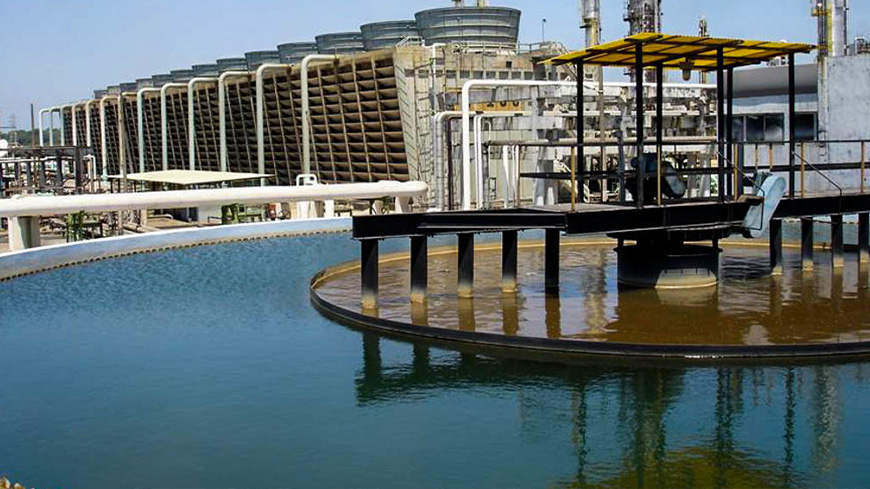
Cooling-water systems constantly circulate water around heat-transferring equipment. As the water flows dissolved minerals can become more concentrated, raising the chances of mineral deposition.
ATMP can be incorporated into a treatment formulation to contribute to:
- Scale inhibition
- Metal-ion control
- Mineral precipitation control
- Corrosion-control programs
- Overall water-treatment performance
Maxwell lists cooling-water treatment among the applications for its ATP 50 % product.
I see that Maxwell’s listing is often used as a starting point for engineers.
The suitable formulation will depend on the quality of water, operating temperature, cycles of concentration, equipment materials and other treatment chemicals.
ATMP in Treatment
Cooling-water systems keep water moving all the time, around equipment that transfers heat. When the water moves dissolved minerals can build up. This makes it more likely that these minerals will form deposits over time.
When dissolved minerals become concentrated and settle on heat-transfer surfaces deposits can disrupt the operations. Increase maintenance requirements.
ATMP can be incorporated into a formulation for boiler-water treatment, to assist with scale and metal-ion management.
However ATMP alone should not be considered a boiler-water treatment program. Boiler chemistry normally requires attention to factors such as quality, alkalinity, dissolved solids, operating pressure and other treatment chemicals.
Maxwell identifies boiler treatment as one of the applications for its PHOSPHOMAN®-222-C ATP 50 % product.
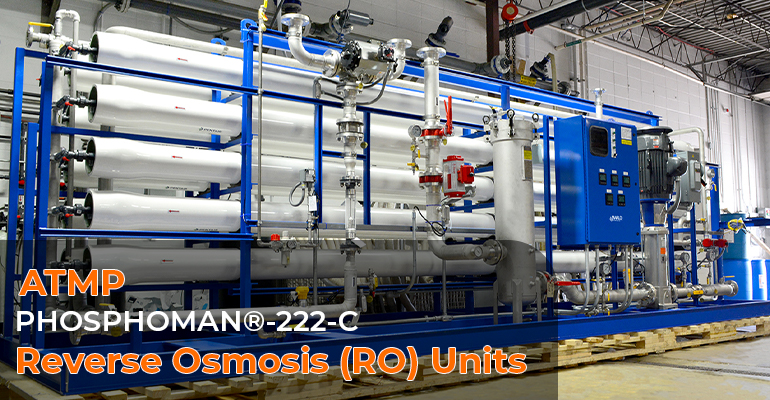
ATMP in Reverse Osmosis Systems
Reverse osmosis systems are very sensitive to mineral deposits, because scale can develop on the membranes when feed-water chemistry is not managed properly.
ATMP can be part of an antiscalant formulation for RO applications.
ATMP’s role is to help to control mineral salt precipitation in the feed water. I have seen ATMP in RO projects to reduce membrane fouling significantly.
For RO applications product choice should be based on analysis. Important parameters can include:
- Calcium concentration
- Magnesium concentration
- Silica
- Sulphate
- Bicarbonate
- pH
- Temperature
- Total dissolved solids
- Recovery rate
Maxwell lists reverse-osmosis desalination among the applications of its ATMP 50 % product.
ATMP in Detergent and Cleaning Formulations
ATMP is used also outside of water-treatment systems.
Cleaning formulations can encounter minerals and dissolved metal ions that reduce cleaning performance or cause deposits.
ATMP can be included where metal-ion management and mineral control is needed.
Maxwell lists soap and detergent, industrial and institutional cleaning, acid cleaners, bottle washing formulations and railway-carriage cleaning among the applications for PHOSPHOMAN®-222-C.
The correct formulation will depend on the ingredients, surfactants, builders, acids, alkalinity regulators and other functional additives.
ATMP in Textile Processing
Textile processing uses a lot of water. The minerals, in the water can affect how chemicals work during the process.
Metal ions can interact with dyes, bleaching chemicals or other ingredients. Mineral deposits can also cause processing problems.
ATMP can be considered where metal-ion and mineral control is needed.
Its suitability should be evaluated in accordance with the textile process, water quality, temperature, pH and other chemicals involved.
Maxwell identifies textile bleaching and textile scouring among the applications of its ATP product.
ATMP in Oilfield Applications
Oilfield water systems may face conditions, such as high mineral content and changes, in temperature and pressure.
Scale deposition can hurt equipment and block flow paths. Therefore scale deposition becomes a factor in many treatment programs and mineral control is essential.
ATMP can be part of oilfield treatment formulations when scale and metal‑ion management are needed and ATMP helps manage scale and metal ions.
Selection of the appropriate formulation will depend on the following considerations: water chemistry, mineralogy, operating conditions, and the purpose of the process. It is important that the formulation used meets all these considerations.
Maxwell lists top-side oilfield applications. Squeeze treatment in oil recovery among its ATP applications.
ATMP, for Other Industrial Applications
ATMP’s versatility means that it can be considered for industrial formulations.
Depending on the process requirements applications can include:
- Pulp and paper processing
- Peroxide stabilization
- cleaning
- Sugar refining
- Metal passivation
- Cement-related formulations
- Ore flotation
- Leather chemical formulations
- Aluminum etching
- Geothermal water treatment
These applications do not necessarily require the formulation or treatment level. The role of ATMP should always be determined in accordance with the process chemistry.
Maxwell’s current product information lists a range of these applications for PHOSPHOMAN®-222-C.
What Factors Affect ATMP Performance?
A common mistake when buying a water-treatment chemical is to consider the product but overlook the system where it will be used.
ATMP performance can be influenced by variables.
1. Water Chemistry
The concentration and mix of dissolved minerals will influence the potential for scale formation.
2. PH
Changes in pH can affect mineral precipitation, and the behavior of ATMP.
3. Temperature
Temperature change can alter mineral solubility, and deposit conditions.
4. Mineral Composition
Different minerals have behaviors. A treatment program designed for one type of scale will not automatically give the results against another.
5. Treatment Chemicals
ATMP is often used in conjunction with treatment components. Compatibility should be evaluated before combining chemicals at production scale.
6. Operating Conditions
Pressure, flow, residence time, cycles of concentration and equipment materials can influence treatment performance.
7. Product Concentration
The concentration in the ATMP grade will affect dosing calculations and formulation design.
Taking these variables into account helps users to move from buying Amino Trimethylene Phosphonic Acid (ATMP) 50 % to choosing a product that’s right for the intended application.
ATMP and Formulation Compatibility
Industrial treatment formulations can contain ingredients.
A formulation may combine phosphonates with:
- dispersants
- Corrosion inhibitors
- phosphonates
- Surfactants
- Builders
- pH-control chemicals
- Specialty additives
The compatibility of these components needs to be evaluated under the real conditions of the formulation.
Useful laboratory evaluations can include:
- Appearance after mixing
- Stability during storage
- Precipitation tendency
- pH changes
- Performance under operating temperature
- Compatibility with ingredients
This is particularly important when developing a new formulation, or changing from one ATMP supplier to another.
Why Consistency Matters in ATMP Supply
For a manufacturer consistency can be as important as the identity of ATMP.
If the active content or other product characteristics vary significantly between batches the formulation or treatment program may have to undergo repeated adjustments.
A reliable Amino Trimethylene Phosphonic Acid Manufacturer in India should therefore provide specifications. Maintain consistent manufacturing and quality-control practices.
Important information for buyers can include:
- content
- Appearance
- pH
- Specific gravity
- Packaging
- Batch information
- Storage recommendations
- Technical documentation
Maxwell’s listed ATMP 50 % specifications include aqueous appearance, colourless to pale-yellow colour, liquid physical state, 49–51 % active content as acid, pH below 2 for a 1 % solution at 25 °C and specific gravity of 1.31–1.35 at 25 °C.
How to Choose an Amino Trimethylene Phosphonic Acid Supplier in India
When selecting an Amino Trimethylene Phosphonic Acid Manufacturer and supplier in India purchasers should go beyond the quoted price.
A practical supplier evaluation can include:
- Product consistency: Check whether the supplier can maintain the required specification from batch to batch.
- Information: Product specifications should be clearly provided.
- Application understanding: The supplier should be able to discuss the intended application and suitability of ATMP.
- Packaging: packaging suitable for transportation, storage and consumption requirements.
- Production capability: Regular industrial consumption requires a supplier with manufacturing and supply capacity.
- Quality control: Consistent testing is important in formulations.
- Supply reliability: Delayed chemical supply can affect production and treatment programs.
- support: Application-specific questions may require expert input from a chemical supplier.
Amino Trimethylene Phosphonic Acid Manufacturer in India: What buyers should check
Looking for an Amino Trimethylene Phosphonic Acid Manufacturer in India can provide options but not all suppliers will offer the product characteristics and level of support.
Before placing an order purchasers can ask:
- What is the active-content specification?
- What are the standard physical properties?
- What packing options are available?
- Is documentation provided?
- Can the product be evaluated for the intended application?
- How is batch consistency maintained?
- What supply volumes can be supported?
- Is technical assistance available?
Why Choose Maxwell Additives for ATMP?
Maxwell Additives offers Amino Trimethylene Phosphonic Acid (ATMP) 50 % in its PHOSPHOMAN®-222-C product range.
The company identifies the product as an organophosphonate used for scale inhibition, antiscalant applications, metal-ion control and corrosion-control support. Its listed applications cover cooling-water treatment, boiler treatment, detergents, industrial cleaning, RO desalination, textile processing, oilfield applications and several other industrial processes.
Maxwell’s specialty-chemical information also highlights its PHOSPHOMAN® range in terms of properties such as water stability, metal binding, water solubility and compatibility, with formulation parts.
For purchasers the combination of product information, application know-how and specialty-chemical manufacturing expertise makes Maxwell a practical choice when sourcing ATMP for a formulation or treatment program.
Conclusion
Amino Trimethylene Phosphonic Acid (ATMP) is an organophosphonate used when it is essential to control metal ions, mineral build-up and scale. ATMP’s common roles in formulations are scale inhibition and metal-ion management but its application stretches beyond ordinary water treatment. ATMP can be blended into cooling-water, boiler, RO, detergent, cleaning, textile, oilfield, pulp and paper and other industrial formulations. For a purchaser choosing the product means looking beyond the chemical name. The concentration, water chemistry, operating conditions, formulation compatibility, product consistency and technical requirements of the application must all be considered. Amino Trimethylene Phosphonic Acid (ATMP) 50% can be a part of a treatment or formulation program when chosen and evaluated in accordance with the real process requirements. For companies looking for an Amino Trimethylene Phosphonic Acid Manufacturer and supplier in India checking product specifications, manufacturing capability, quality consistency and technical support can help establish a long-term supply relationship.
Frequently Asked Questions
1. What is Amino Trimethylene Phosphonic Acid (ATMP)?
Amino Trimethylene Phosphonic Acid (ATMP) is an organophosphonate that is used in formulations to manage metal ions, inhibit scale and control mineral precipitation.
2. What is Amino Trimethylene Phosphonic Acid (ATMP) 50%?
Amino Trimethylene Phosphonic Acid (ATMP) 50% is a water-based grade of ATMP. Maxwell’s PHOSPHOMAN®-222-C specification shows a content of 49–51% acid.
3. What is ATMP used for?
ATMP is used in cooling-water treatment, boiler treatment, RO desalination, detergents, industrial cleaning, textile processing, oilfield work and many other industrial formulations.
4. Is ATMP a scale inhibitor?
Yes. ATMP is commonly used as a scale inhibitor and antiscalant because ATMP can affect metal-ion activity and stop mineral salt precipitation under conditions.
5. Can ATMP be used in RO systems?
Yes. ATMP can be used as part of antiscalant formulations for reverse-osmosis systems. The right product and treatment level must be chosen based on the chemistry.
6. Can ATMP be used for treatment?
Yes. Cooling-water treatment is one of the applications for Maxwell’s ATMP 50% product.
7. How should ATMP 50% be selected?
Choosing ATMP 50% should look at content, water chemistry, mineral composition, pH, temperature, operating conditions, compatibility with chemicals and the needs of the final application.
8. What should I check when selecting an Amino Trimethylene Phosphonic Acid Manufacturer in India?
When choosing an Amino Trimethylene Phosphonic Acid Manufacturer in India purchasers should check product consistency, active-content specifications, quality control, technical documentation, packaging, manufacturing capability, supply reliability and technical support.
9. Who supplies Amino Trimethylene Phosphonic Acid in India?
Maxwell Additives supplies Amino Trimethylene Phosphonic Acid (ATMP) 50% in its PHOSPHOMAN®-222-C product range, for applications.
Related Posts