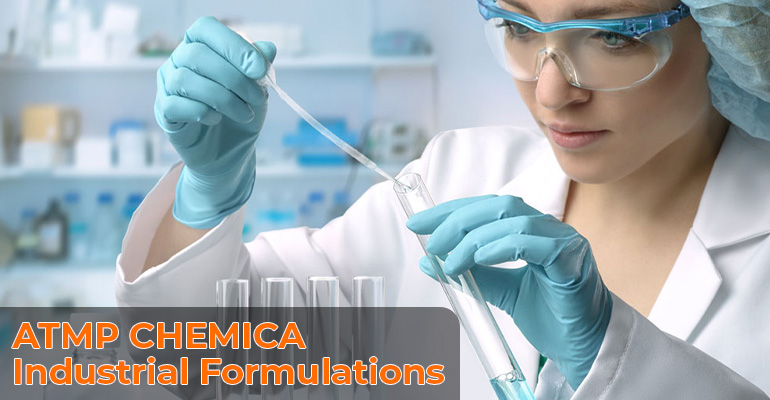
ATMP Chemical stands for Amino Trimethylene Phosphonic Acid, a phosphonate-based chemical used in industrial formulations where controlling dissolved metals and unwanted mineral deposits is important. It is commonly supplied as an aqueous liquid, with ATMP 50% being a widely used commercial concentration. Its chemical structure allows it to interact with metal ions, making it useful in water-treatment and other process applications...
ATMP Chemical: Understanding Its Industrial Applications
 What is ATMP Chemical?
ATMP Chemical stands for Amino Trimethylene Phosphonic Acid, a phosphonate-based chemical used in industrial formulations where controlling dissolved metals and unwanted mineral deposits is important. It is commonly supplied as an aqueous liquid, with ATMP 50% being a widely used commercial concentration. Its chemical structure allows it to interact with metal ions, making it useful in water-treatment and other process applications.
In simple terms, ATMP can help industries manage the behavior of minerals present in water and process liquids. Calcium, magnesium and other metal ions can contribute to deposits or interfere with industrial operations. ATMP helps control these interactions through its phosphonate functionality, which is why it is considered useful in formulations designed for scale management and metal-ion control.
The chemical is not limited to one particular industry. It can be considered in cooling-water programs, boiler treatment, industrial cleaning, detergent formulations, textile processing, oilfield applications, desalination systems and several other specialized processes. The exact dosage and suitability depend on water chemistry, operating conditions and the complete formulation.
For industrial buyers, the choice of an ATMP Chemical Manufacturer is important because consistency in active content and physical characteristics can affect formulation performance. A reliable ATMP Chemical Supplier can also help manufacturers maintain continuity when the chemical is required regularly for large-scale production.
ATMP Chemical for Mineral Control and Industrial Water Treatment
ATMP is best understood as a chemical that helps manage mineral chemistry rather than simply acting as a conventional cleaning ingredient. When dissolved metal ions begin participating in reactions that can create deposits, phosphonate chemistry can interfere with those processes and help keep the system under better control.
One of its useful characteristics is its ability to work at relatively low concentrations in suitable applications. This means that the desired result does not necessarily require adding a large quantity of chemicals. The actual treatment level, however, should always be established through testing because different water compositions and operating conditions can produce very different results.
ATMP can also become part of a broader treatment program. Industrial systems often use several chemicals together rather than relying on one ingredient. In such situations, ATMP may be selected alongside other phosphonates, polymers, corrosion-control ingredients or complementary treatment chemicals.
This makes product compatibility an important consideration. A chemical that performs well individually may behave differently when combined with other components. Manufacturers should therefore evaluate the complete formulation before moving from laboratory trials to commercial production.
For businesses looking for an ATMP Chemical Manufacturer and supplier, technical documentation, batch consistency, packaging, supply reliability and application support can be just as important as the purchase price.
Features of ATMP Chemical
1. Strong Metal-Ion Interaction
ATMP has phosphonic acid groups that can interact strongly with various metal ions. This characteristic makes it useful in formulations where dissolved minerals need to be controlled. Its ability to bind with selected metal species supports its use in water-treatment and industrial systems where mineral-related problems can reduce process efficiency.
2. Scale-Control Function
ATMP can interfere with the formation and growth of mineral deposits under suitable treatment conditions. Rather than simply removing an existing deposit, it is commonly incorporated into preventive treatment programs. This makes the chemical valuable where industries want to reduce the chance of scale developing during continuous operation.
3. Useful at Low Treatment Levels
A notable characteristic of ATMP is its threshold activity, allowing it to provide useful scale-control effects at comparatively low concentrations in appropriate systems. This can help formulators design economical treatment programs while maintaining chemical control. Actual dosage should always be determined according to water chemistry and operating conditions.
4. Good Chemical Stability
ATMP is valued for its stability in demanding industrial environments. This characteristic allows it to remain useful across different treatment conditions and supports its application in systems exposed to changing temperatures or chemical environments. Performance should still be verified against the specific conditions of the intended process.
5. Water-Based Liquid Availability
ATMP is commonly supplied as an aqueous liquid, including a widely used 50% grade. The liquid format can make storage, metering and blending convenient for industrial users with suitable dosing equipment. Maxwell Additives lists its ATMP 50% product as a clear aqueous solution supplied in multiple industrial package sizes.
6. Chelating Capability
ATMP can form complexes with metal ions, which is one of the main reasons it is used in industrial chemical formulations. This chelating behavior can help manage ions that otherwise participate in unwanted reactions. The effectiveness depends on the particular metal, concentration, pH and overall chemistry of the system.
7. Versatile Industrial Compatibility
ATMP can be considered for several industrial formulations rather than a single specialized application. Its use across water treatment, cleaning, detergents, textile processing and other sectors demonstrates its broad chemical utility. Each application requires its own formulation assessment to establish compatibility, dosage and performance.
How ATMP Chemical Supports Industrial Operations
Industrial water and process systems can become difficult to manage when mineral ions remain uncontrolled. Deposits may develop on equipment surfaces, while certain dissolved metals can interfere with other chemicals. ATMP provides a way to address part of this challenge through phosphonate-based metal-ion control.
For example, in a circulating water system, minerals repeatedly move through pipes, heat-transfer equipment and other components. Changes in temperature and concentration can encourage deposition. A suitable ATMP-based treatment program can help interfere with these processes and reduce the conditions that encourage hard deposits.
The same concept can be valuable in cleaning formulations. Cleaning products may encounter mineral-rich water or metal surfaces during use. Including a suitable chelating or sequestration component can help manage metal ions and support more consistent formulation behavior.
Amino Trimethylene Phosphonic Acid is also useful when formulators need a chemical that can work alongside other treatment ingredients. Instead of designing a complete treatment system around one raw material, manufacturers can use ATMP as one component of a broader chemical program.
Another practical advantage is its availability in concentrated liquid form. For facilities using regular dosing systems, a liquid raw material can simplify handling and controlled addition. The correct storage conditions, dosing method and concentration should nevertheless be determined from the product’s technical and safety information.
 Benefits of ATMP Chemical
1. Helps Control Mineral Deposits
ATMP can help reduce the formation and development of mineral deposits in suitable water-treatment systems. By interacting with scale-forming metal ions and interfering with precipitation processes, it supports preventive treatment strategies. This can help industries maintain more stable operating conditions and reduce deposit-related maintenance concerns.
2. Supports Better Water-System Management
Water systems often contain several dissolved minerals that can behave differently as temperature, concentration and pH change. ATMP provides a useful tool for managing some of these mineral interactions. When properly dosed, it can become part of a broader program designed to maintain consistent system performance.
3. Useful for Industrial Cleaning
ATMP can be incorporated into suitable cleaning formulations where metal-ion control is required. Hard-water minerals and dissolved metals can interfere with cleaning chemistry, so controlling them may support better formulation behavior. Its use should be matched with the other ingredients and the intended cleaning conditions.
4. Supports Equipment Protection
Uncontrolled mineral deposition can contribute to operational difficulties in pipes, heat-transfer surfaces and process equipment. ATMP can help prevent such deposits under appropriate conditions, supporting cleaner equipment surfaces. It is not a replacement for complete maintenance practices, but it can contribute to a preventive chemical-treatment strategy.
5. Suitable for Multiple Industries
ATMP is useful across different industrial sectors because mineral-control challenges occur in many processes. Its applications include water treatment, detergents, cleaning, textiles, oilfield operations and other specialized areas. This broad usability allows chemical formulators to consider one phosphonate for several technically different product categories.
6. Convenient Liquid Handling
ATMP 50% is supplied as an aqueous liquid, making it suitable for controlled dosing and blending in many industrial environments. Liquid handling can be convenient for plants equipped with appropriate pumps and storage systems. The material should always be handled according to its current technical and safety documentation.
7. Helps Improve Formulation Flexibility
ATMP can serve as one component within multi-ingredient chemical formulations. Its ability to interact with metal ions allows formulators to combine it with other suitable treatment chemicals when designing specialized systems. Proper compatibility and dosage trials can help determine the most effective formulation approach.
Conclusion
ATMP Chemical, or Amino Trimethylene Phosphonic Acid, is an important phosphonate raw material for industrial systems where mineral deposition and metal-ion control need attention. Its ability to interact with metal ions, provide threshold scale-control activity and work within different formulations gives it wide industrial relevance.
From cooling-water and boiler programs to cleaning, textiles, detergents, desalination and specialized processing applications, ATMP can support different chemical-treatment objectives. Its liquid form also offers practical advantages for industrial dosing and blending.
For manufacturers, selecting a reliable ATMP Chemical Manufacturer, ATMP Chemical Supplier, or ATMP Chemical Manufacturer and supplier is an important part of maintaining consistent production. Product specifications, batch quality, technical documentation, packaging and supply reliability should all be considered before making a purchase.
FAQs
1. What is ATMP Chemical mainly used for?
ATMP Chemical is mainly used in industrial formulations where scale formation and metal-ion activity need to be controlled. It is commonly considered for water treatment, cooling-water systems, boiler treatment, cleaning formulations, detergents, textile processing, desalination and other applications requiring phosphonate-based chemical control.
2. Is ATMP available in liquid form?
Yes. ATMP is commonly supplied as an aqueous liquid, with ATMP 50% being a widely used commercial grade. Maxwell Additives’ published specification describes its ATMP 50% as a clear aqueous solution with 49–51% acid active content.
3. Can ATMP be used in cooling-water treatment?
Yes, ATMP can be included in suitable cooling-water treatment programs. Its scale-control and metal-ion interaction properties can help manage mineral deposition under appropriate operating conditions. The correct dosage should be determined according to the water analysis and the complete treatment program.
4. Why is ATMP used with other water-treatment chemicals?
Industrial water systems usually have more than one problem to manage. Scale, corrosion, suspended particles and microbial growth may require different treatment approaches. ATMP can serve as one component of a broader program, while other chemicals address requirements that ATMP alone cannot cover.
5. What should I check before buying ATMP?
Buyers should check active concentration, appearance, density, pH, packaging, technical specifications, batch documentation and supplier consistency. They should also confirm that the selected grade is appropriate for the intended application. Reliable communication with the ATMP Chemical Manufacturer and supplier can make technical evaluation easier.
6. Is ATMP suitable for industrial cleaning formulations?
ATMP can be used in suitable industrial and institutional cleaning formulations, particularly where metal-ion control is useful. It can help manage mineral-related interference in appropriate systems. The final concentration and compatibility with surfactants, builders and other ingredients should be confirmed through formulation testing.
7. Why choose a reliable ATMP Manufacturer and supplier?
A reliable ATMP Manufacturer and supplier can provide consistent material quality, appropriate packaging, technical documentation and dependable supply. For industries using ATMP continuously, these factors can reduce raw-material variation and make production planning easier. Maxwell Additives lists ATMP 50% among its specialty phosphonate products.
Related Posts