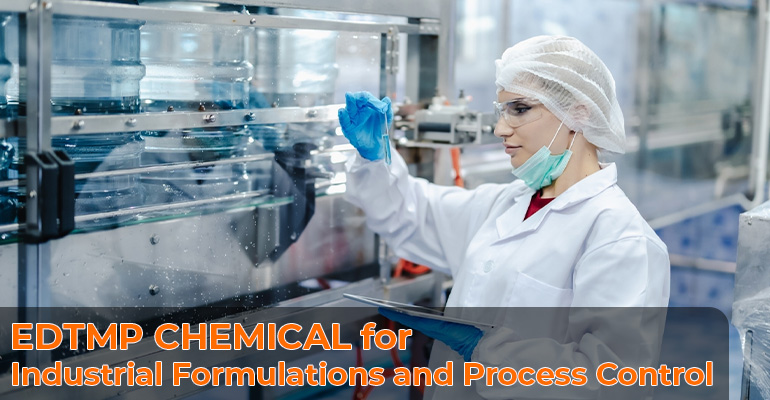

Ethylenediamine Tetra(Methylenephosphonic) Acid – EDTMPA is a type of phosphonic acid that has groups that can be used to bind metal ions and stop scale forming in industrial mixtures. Its success depends on the use, of water, mixture and details...
EDTMP Chemical: Role in Consistent Industrial Formulations

Ethylenediamine Tetra(Methylenephosphonic) Acid – EDTMP is an organophosphonic acid that can be considered in formulations where metal-ion management and mineral-control properties are required. Maxwell Additives lists PHOSPHOMAN-124 as EDTMPA with multiple properties including sequestration, deflocculation, threshold inhibition, and hydrolytic stability.
Rather than presenting EDTMP only as another scale inhibitor, this article looks at how the chemical can be evaluated as part of a controlled formulation. This approach is useful for manufacturers who need consistent results when their products are exposed to different mineral conditions or contain multiple active ingredients.
What is an EDTMP Chemical?
EDTMP Chemical stands for Ethylenediamine Tetra(Methylenephosphonic) Acid, commonly abbreviated as EDTMP, EDTMPA, or EDTMP Acid. It belongs to the organophosphonic acid family and contains multiple phosphonic acid groups associated with an ethylenediamine-based structure.
These functional groups give EDTMP the ability to interact with dissolved metal ions. This property is useful when metals present in water or other process environments can influence precipitation, dispersion, or the performance of other formulation ingredients.
Maxwell Additives identifies PHOSPHOMAN-124 as Ethylenediamine tetra(Methylenephosphonic) Acid, with CAS No. 1429-50-1 and molecular weight 436. The product is described as a crystalline powder with a minimum active content of 92% as acid, moisture below 8%, chloride content below 0.5%, and iron content below 15 ppm.
It is important to distinguish the acid form from the penta-sodium salt form. Maxwell also lists PHOSPHOMAN-124(S5), which is the penta-sodium salt of Ethylene Diamine Tetra(Methylene Phosphonic Acid), supplied as a liquid with different specifications.
Therefore, when purchasing or formulating with EDTMPA, the exact grade and chemical form should be confirmed rather than assuming that all EDTMP products have identical characteristics.
The powder form of EDTMP Acid also means that handling and incorporation require a different approach from liquid phosphonates. Moisture, dissolution behavior, weighing accuracy, and mixing procedure can become important during formulation.
Understanding these differences helps manufacturers use EDTMP Chemical more accurately. Instead of treating EDTMP simply as a generic phosphonate, its grade, concentration, physical form, and intended application should all be considered when developing a finished chemical product.
EDTMP Chemical and Controlling Formulation Variations
A major challenge in industrial formulation is that the surrounding chemical environment can change even when the product recipe remains the same.
For example, water used during production may contain different levels of calcium, magnesium, iron, or other dissolved minerals. The raw materials may also introduce trace metals. Once these substances enter the formulation, they can interact with other ingredients and potentially affect the final product.
This is where the metal-binding characteristics of EDTMP become relevant. Maxwell describes PHOSPHOMAN-124 as having excellent iron sequestration, high threshold inhibition and dispersion, good calcium compatibility, and very good inhibition of calcium carbonate and calcium sulfate.
The practical question is not simply whether EDTMP can interact with metals. It is how that interaction affects the complete formulation.
Consider a formulation prepared with hard water. Calcium and magnesium are already present before the active ingredients are added. If another component reacts with these ions, the formulation may develop turbidity, precipitation, or reduced performance.
A formulation containing EDTMP can be evaluated under the same water conditions that the final product will encounter. This provides a more realistic picture of its behavior than testing only in highly purified laboratory water.
Iron can create another variable. Trace iron may interact with chemicals used in sensitive industrial processes. If the formulation is intended for repeated production, monitoring metal levels can help identify whether changes in raw materials or process water are affecting product consistency.
Concentration is another important factor. A raw material with a defined active content needs to be calculated correctly when it is added to a finished formulation. The commercial concentration is not automatically the same as the concentration required during application.
This distinction becomes especially important when comparing powder and salt forms of EDTMP. The acid form and penta-sodium salt have different active-content specifications and physical characteristics.
A controlled formulation therefore starts with understanding exactly which EDTMP grade is being used. From there, manufacturers can evaluate dissolution, compatibility, concentration, pH, storage behavior, and application performance.
This approach makes EDTMP Acid more than a functional ingredient. It becomes one part of a broader formulation-control strategy in which raw-material quality and process conditions are considered together.
Features of EDTMP Chemical
1. Strong Metal-Ion Interaction
EDTMP can interact with dissolved metal ions, making it useful where metals influence mineral behavior or the stability of other ingredients. Its sequestration capability is one of the important characteristics of the chemical.
2. High Active Content in Acid Form
Maxwell lists PHOSPHOMAN-124 with a minimum active content of 92% as acid. This relatively high active specification is important when calculating the amount of raw material required for a formulation.
3. Iron Sequestration
EDTMP is identified by Maxwell as offering excellent iron sequestration. This can be valuable in formulations where trace iron needs to be managed to maintain the desired chemical environment.
4. Calcium Compatibility
Good calcium compatibility allows EDTMP to be evaluated in systems containing significant calcium levels. This is relevant where mineral-rich conditions could otherwise influence the performance of a formulation.
5. Threshold Inhibition
EDTMP can influence mineral precipitation through threshold inhibition. This allows it to be considered where controlling mineral formation is required without treating the chemical solely as a conventional stoichiometric sequestering agent.
6. Deflocculation and Dispersion
Maxwell identifies deflocculation and dispersion among the properties of PHOSPHOMAN-124. These characteristics can contribute to formulations where controlling the behavior of suspended or precipitating particles is important.
7. Hydrolytic Stability
EDTMP is described as having high hydrolytic stability. This property is relevant when the chemical is exposed to demanding process conditions and needs to retain its functionality within the intended application environment.
Building a Consistent Formulation With EDTMP
When a specialty chemical is used repeatedly in manufacturing, consistency becomes as important as initial performance. A formulation that works once in a laboratory test is not necessarily ready for large-scale production.
For EDTMP Chemical, one useful starting point is to establish the exact material specification. Active content, moisture, iron, chloride, appearance, and physical form can all influence how the raw material is incorporated.
Maxwell’s PHOSPHOMAN-124 specification gives a minimum 92% active content, moisture below 8%, chloride below 0.5%, and iron below 15 ppm. These values provide measurable checkpoints for evaluating the acid-grade raw material.
The next consideration is dissolution. Because the acid form is supplied as a crystalline powder, the method used to introduce it into a liquid formulation can affect how quickly and uniformly it becomes incorporated.
Water quality should also be considered during dissolution. Hardness and dissolved metals can alter the chemical environment before the remaining ingredients are even added. Testing with representative process water can therefore provide more useful information than relying only on laboratory-grade water.
The addition sequence is another practical variable. When several concentrated chemicals are introduced into one mixing vessel, temporary local concentrations can be much higher than the final concentration. A controlled addition sequence can help reduce unwanted interactions and improve batch uniformity.
The finished formulation should then be examined rather than assuming that successful mixing means the product is stable. Depending on the application, useful checks may include appearance, pH, precipitation, sediment, viscosity, active content, and storage stability.
Temperature can also affect the final product. A formulation intended for a demanding industrial process should be tested under representative conditions rather than only at room temperature.
Another useful step is to compare different EDTMP concentrations. This does not mean simply increasing the dosage until a desired result appears. Controlled concentration trials can help identify the level at which EDTMP provides the intended function without unnecessarily changing the rest of the formulation.
This type of testing creates a more complete understanding of EDTMPA. It considers the raw material, production process, formulation chemistry, and final application together.
EDTMPA in Multi-Component Chemical Systems
Many modern industrial formulations rely on combinations of ingredients rather than one active chemical. A phosphonate may be used alongside polymers, surfactants, corrosion-control materials, cleaning agents, or other specialty chemicals.
In such systems, the performance of EDTMP Acid should be evaluated as part of the complete mixture.
One ingredient may affect pH while another interacts with metal ions. A third may influence dispersion or particle behavior. These interactions can sometimes change the properties of the final product, even when each individual ingredient performs well when tested separately.
This is why compatibility testing is an important part of formulation development.
The physical form of EDTMP also needs consideration. Maxwell’s acid-grade PHOSPHOMAN-124 is a crystalline powder, while the penta-sodium salt PHOSPHOMAN-124(S5) is supplied as a liquid. The two forms therefore should not be treated as interchangeable raw materials without reviewing their respective specifications.
A manufacturer may select one form based on the requirements of its formulation, handling process, desired concentration, or final product characteristics.
Storage is another consideration. A powder-grade material should be protected from conditions that could increase moisture uptake or compromise handling characteristics. The finished formulation should likewise be monitored for physical changes during its expected storage period.
These checks become especially valuable when an EDTMP-based formulation is produced at scale. Small variations that are difficult to notice in a laboratory sample can become more significant when hundreds or thousands of kilograms are manufactured.
For this reason, EDTMPA can be evaluated through a structured formulation process: confirm the grade, measure the required active level, test dissolution, examine compatibility, reproduce realistic process conditions, and monitor the finished product.
Such an approach helps manufacturers understand the actual contribution of EDTMP instead of relying only on a general list of chemical properties.
Benefits of EDTMP Chemical
1. Supports Metal-Ion Management
EDTMP can interact with dissolved metal ions and help manage their influence within industrial formulations. This can be useful when calcium, iron, or other metals may interfere with other ingredients or contribute to unwanted mineral reactions.
2. Helps Maintain Formulation Control
A clearly specified EDTMP grade gives formulators a measurable basis for preparing consistent batches. Active content, moisture, iron, and chloride specifications can help technical teams monitor the quality of incoming material.
3. Useful Under Demanding Conditions
EDTMP is described as having high hydrolytic stability and suitability for demanding environments involving temperature, pressure, and salinity. This makes it worth evaluating when a formulation must operate under more challenging industrial conditions.
4. Offers Calcium Compatibility
Good calcium compatibility makes EDTMP relevant to formulations exposed to calcium-rich conditions. It can be evaluated where mineral composition changes during operation and where calcium interactions may influence the behavior of other chemical components.
5. Provides Dispersion Support
The deflocculation and dispersion properties associated with EDTMP can be useful when controlling the behavior of suspended or precipitating material is part of the formulation objective. This adds another functional dimension beyond simple metal sequestration.
6. Available in Different Chemical Forms
EDTMP is available in acid and penta-sodium salt forms within Maxwell’s product range. The availability of different forms allows manufacturers to evaluate which physical and chemical format fits their particular formulation and handling requirements.
7. Suitable for Multiple Formulation Areas
EDTMP can be evaluated in applications including detergents, cement-related formulations, textile processing, and oilfield chemicals. Its usefulness across these areas comes from its combination of metal interaction, mineral-control, and stability characteristics.
Maxwell Additives: Consistency Across Every EDTMP Grade
At Maxwell Additives, our approach to EDTMP focuses on providing clearly defined grades that help manufacturers make informed formulation decisions. PHOSPHOMAN-124 is offered as a crystalline EDTMP acid with a minimum active content of 92%, while PHOSPHOMAN-124(S5) is available in penta-sodium salt form as a liquid. Maintaining clear specifications across these product forms allows formulators to assess the material according to their processing method, dosage requirements, and application conditions. Our focus is on delivering consistent phosphonate quality that can be evaluated reliably during formulation development and production.
Conclusion
Ethylenediamine Tetra(Methylenephosphonic) Acid – EDTMP is a multifunctional organophosphonic acid that can contribute to industrial formulations where metal-ion interaction, mineral control, dispersion, and formulation stability are important.
Rather than looking at EDTMP Chemical only as a scale-control ingredient, manufacturers can evaluate it as part of a broader formulation strategy. Its active concentration, physical form, compatibility with other ingredients, and response to changing water chemistry can all influence the final product.
The distinction between EDTMPA acid and its penta-sodium salt is also important. Maxwell Additives lists PHOSPHOMAN-124 as the crystalline acid form with a minimum 92% active content, while PHOSPHOMAN-124(S5) is the penta-sodium salt supplied as a liquid with a different specification.
For manufacturers using EDTMP Acid, controlled testing can provide a better understanding of how the material behaves in the actual formulation. Checking raw-material specifications, dissolution, concentration, compatibility, storage stability, and application conditions can help create a more consistent chemical product.
Ultimately, EDTMP becomes most useful when its properties are matched carefully with the requirements of the complete formulation rather than treated as a one-purpose chemical.
FAQs About EDTMP Chemical
1. What is EDTMP Chemical?
EDTMP Chemical is the abbreviation commonly used for Ethylenediamine Tetra(Methylenephosphonic) Acid. It is an organophosphonic acid that can interact with metal ions and is used in industrial formulations where sequestration, threshold inhibition, dispersion, and mineral control are required. Maxwell Additives identifies PHOSPHOMAN-124 as its EDTMP acid product.
2. Is EDTMP the same as EDTMPA?
Yes. EDTMP and EDTMPA are commonly used abbreviations for Ethylenediamine Tetra(Methylenephosphonic) Acid. The term EDTMP Acid is also used for the acid form. However, buyers should distinguish these terms from the penta-sodium salt because the salt has different physical and chemical specifications. Maxwell lists both forms in its product range.
3. What is the active content of Maxwell’s EDTMP acid?
Maxwell Additives specifies PHOSPHOMAN-124, its EDTMP acid product, with a minimum active content of 92% as acid. The published specification also lists moisture below 8%, chloride below 0.5%, and iron below 15 ppm. These are typical values, and the applicable final product specification should be confirmed before use.
4. Is EDTMP available as a liquid?
The acid form of PHOSPHOMAN-124 listed by Maxwell is a crystalline powder. Maxwell also offers PHOSPHOMAN-124(S5), the penta-sodium salt of EDTMP, as a liquid product. Since these forms have different compositions and specifications, they should not be substituted for one another without checking formulation requirements.
5. Can EDTMP be used with other formulation ingredients?
EDTMP can be incorporated into multi-component formulations, but compatibility should be established through application-specific testing. Other phosphonates, polymers, surfactants, pH modifiers, and process chemicals can affect the behavior of the complete formulation. Testing the finished mixture is more reliable than assuming compatibility from individual ingredient properties.
6. Why is iron content important in EDTMP?
Iron can influence the behavior of sensitive industrial formulations, particularly when trace-metal control is important. Maxwell’s published specification for PHOSPHOMAN-124 lists iron below 15 ppm. Monitoring this parameter can help manufacturers maintain better control over raw-material quality and investigate formulation variations when they occur.
7. What should manufacturers check before using EDTMP Acid in a new formulation?
Manufacturers should review the exact EDTMP grade, active content, moisture, physical form, metal and chloride specifications, dissolution behavior, and compatibility with other ingredients. Application testing should also consider the actual water quality, pH, temperature, mineral concentration, storage period, and intended dosage so that the formulation is evaluated under realistic conditions.
Related Posts