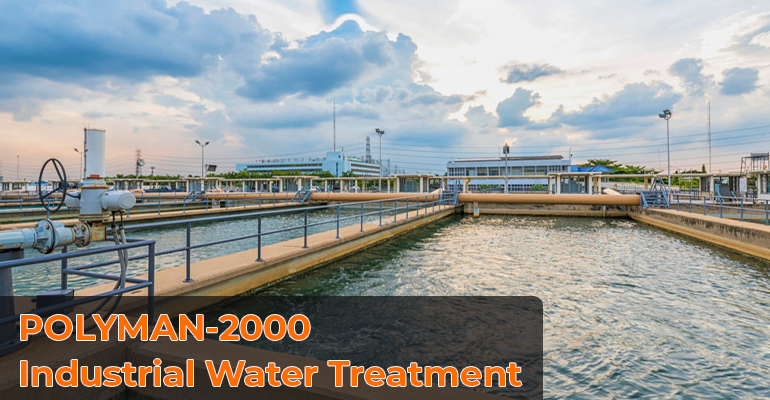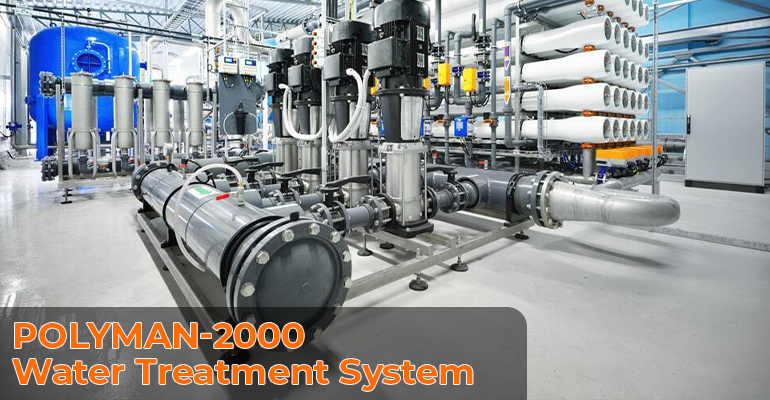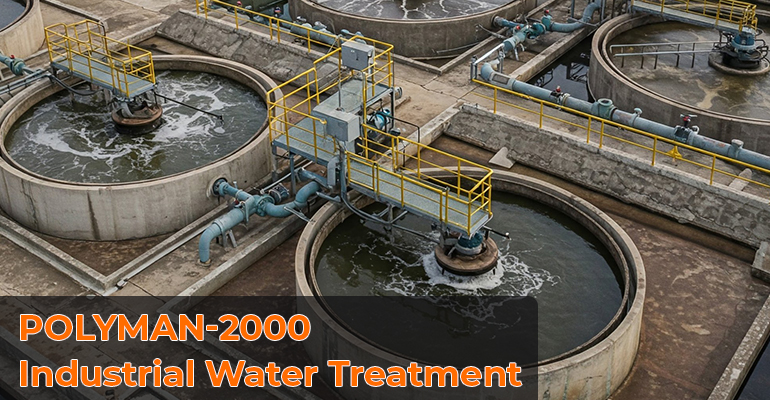
Polymaleic acid POLYMAN-2000 is a polymer-based water treatment chemical designed to help manage mineral deposits and unwanted particulate matter in industrial water systems. It belongs to the family of low-molecular-weight polymers derived from maleic acid and is valued for its ability to interact with mineral particles present in circulating water. Rather than allowing these particles to easily gather and form hard deposits, the polymer helps keep them dispersed so that the operating surfaces remain cleaner...
Maleic Acid: Understanding POLYMAN-2000 in Industrial Water Treatment
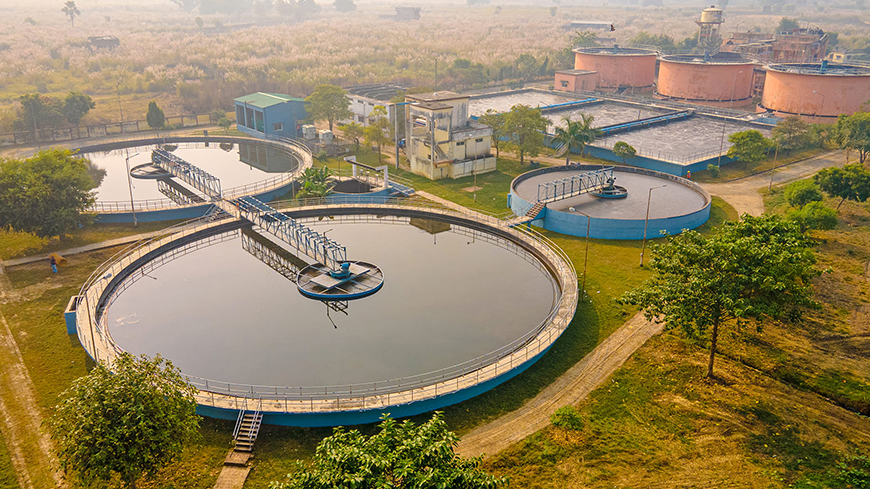 Industrial water treatment is not only about removing unwanted substances from water. In many systems, the bigger challenge is controlling how dissolved minerals and tiny particles behave while the process continues to operate. When these materials begin to interact in an uncontrolled way, they can create deposits, affect heat-transfer surfaces, increase cleaning requirements, and disturb normal plant operation.This is where specialty polymer chemistry becomes useful. POLYMAN-2000 Polymaleic Acid is a maleic-acid-based polymer that can be considered when an industrial formulation requires support for mineral and particulate management.
The product belongs to the polymaleic acid family, while its practical value depends on how it is incorporated into a treatment program. Water composition, temperature, pH, concentration cycles, hardness, dissolved metals, and the presence of other treatment chemicals can all influence the final performance.
For formulators, understanding these factors is more useful than simply looking at a polymer as a single-purpose chemical. The right polymer should match the actual conditions of the system in which it will be used.
What is POLYMAN-2000 Polymaleic Acid?
POLYMAN-2000 Polymaleic Acid is a specialty polymer based on Maleic Acid chemistry and is classified as a maleic homopolymer. Maxwell Additives lists POLYMAN-2000 within its Homo-Polymers range for specialty applications.
Polymaleic acid is formed from maleic-acid-derived chemistry into a polymeric structure. Compared with the individual monomer, the polymer has a different molecular arrangement that makes it useful for industrial formulation work.
The important point is that POLYMAN-2000 should not be viewed simply as another generic water-treatment chemical. It is a polymeric ingredient that can influence the behavior of mineral-containing systems and can be studied alongside other treatment components.
Its usefulness can vary depending on the application. A cooling-water circuit, boiler-related process, industrial formulation, or another water-based system may present completely different chemical conditions. Therefore, product selection should always be connected with actual operating data.
For companies comparing polymaleic acid manufacturers or polymaleic acid suppliers, the product’s consistency, technical information, manufacturing capability, and application support are also important considerations.
How Polymaleic Acid Works in a Water-Based System
When water contains dissolved mineral salts, changes in temperature, concentration, or pH can alter the way those minerals behave.
As water circulates or evaporates, the concentration of dissolved substances can increase. Some materials may then begin to form small particles. If these particles grow or attach to surfaces, they can become more difficult to manage.
A polymer such as POLYMAN-2000 can be evaluated for its ability to influence this particle behavior.
The polymer interacts with mineral species and particulate surfaces through its functional groups. Depending on the chemistry of the system, this interaction can affect particle growth and dispersion.
The result is not necessarily the removal of minerals from the water. Instead, the objective of polymer treatment can be to keep mineral matter in a more controllable state.
This distinction is important because industrial water treatment often aims to manage the behavior of dissolved substances rather than simply eliminate them.
POLYMAN-2000 in Industrial Formulation Development
POLYMAN-2000 can be considered during the development of water-based formulations where polymeric control of mineral and particulate behavior is required.
The development process can start with a small laboratory trial. Different concentrations of the polymer can be tested against a representative water sample.
The formulator can then observe changes in solution appearance, particle formation, stability, and other application-specific parameters.
If the results are promising, the formulation can be tested with other ingredients used in the final commercial product.
This step is important because a polymer that performs well on its own may behave differently when mixed with phosphonates, corrosion inhibitors, surfactants, or other treatment chemicals.
Compatibility should therefore be established before large-scale manufacturing.
Features of POLYMAN-2000 Polymaleic Acid
1. Maleic Acid-Based Polymer Chemistry
POLYMAN-2000 is based on maleic-acid polymer chemistry, giving it a distinct identity within the specialty polymer category. This makes it useful for formulators who want to compare maleic-based materials with acrylic, sulfonated, or other polymer chemistries during the development of industrial water-treatment products.
2. Suitable for Formulation Evaluation
POLYMAN-2000 can be studied as an active polymeric component rather than being restricted to one fixed formulation. Manufacturers can evaluate different concentrations and combinations to understand how the material behaves with their specific water chemistry and existing treatment ingredients before deciding on commercial use.
3. Useful for Mineral-Management Programs
The polymer can be evaluated in systems where mineral particles need to remain more manageable during operation. Its interaction with mineral species can influence particle behavior, making it a candidate for formulations designed around deposit-control requirements. Actual results depend on water chemistry, dosage, temperature, and operating conditions.
4. Supports Dispersion-Oriented Formulations
POLYMAN-2000 can be considered where keeping fine particulate material distributed within the water phase is important. Better particle management can make suspended matter easier to handle within a treatment program. The required concentration should be established through testing rather than applying a universal dosage to every system.
5. Can Be Studied with Other Treatment Chemicals
Industrial formulations often combine several active materials. POLYMAN-2000 can be tested alongside compatible treatment ingredients to determine whether the combined formulation delivers the desired performance. Such evaluation can also identify potential changes in physical stability, appearance, viscosity, or precipitation before the product reaches full-scale production.
6. Adaptable to Different Treatment Conditions
Water systems rarely remain completely constant throughout the year. Changes in makeup water, temperature, production load, and concentration can affect mineral behavior. POLYMAN-2000 can therefore be evaluated under several operating conditions to understand whether the selected formulation maintains acceptable performance when the treatment environment changes.
7. Practical Option for Polymer-Based Treatment Design
For formulators comparing different polymer families, POLYMAN-2000 provides a maleic-based option for laboratory and field evaluation. Its suitability can be compared against other polymers according to deposit-control requirements, compatibility, dosage, operating conditions, and overall formulation economics rather than selecting a material solely by chemical category.
Practical Testing Before Commercial Application
Before introducing POLYMAN-2000 Polymaleic Acid into a full-scale treatment program, laboratory evaluation is recommended.
A basic testing program can compare several polymer concentrations using representative water. The results can then be assessed against the specific objective of the treatment.
Additional tests can examine compatibility with the complete formulation.
Once a suitable concentration range is identified, a controlled field trial can provide information about real operating conditions.
Field evaluation is valuable because industrial systems may experience changes that cannot always be reproduced in a laboratory, including variations in water quality, production load, temperature, and concentration cycles.
This step can help confirm whether the laboratory results translate into practical plant performance.
 Benefits of POLYMAN-2000 Polymaleic Acid
1. Helps Manage Mineral Behavior
POLYMAN-2000 can support treatment programs where mineral particles need to be kept under control. By interacting with mineral species, the polymer can influence particle formation and behavior. This may help formulators develop systems that are better prepared to manage deposit-forming substances during continuous industrial operation.
2. Supports Controlled Particle Dispersion
Uncontrolled particle growth can make mineral matter harder to manage. POLYMAN-2000 can be evaluated where dispersion is part of the treatment objective. Keeping fine material in a more manageable condition can support water-treatment strategies designed to reduce the tendency of particles to gather or settle.
3. Provides a Maleic-Based Polymer Option
Formulators often compare several polymer chemistries before selecting a treatment material. POLYMAN-2000 provides a polymaleic acid option for this evaluation. Its maleic-based structure allows manufacturers to investigate an alternative polymer chemistry according to their water conditions, formulation requirements, and desired treatment performance.
4. Can Be Used in Customized Formulations
Industrial customers rarely have identical water conditions. POLYMAN-2000 can be evaluated within customized formulations developed for specific applications. Manufacturers can adjust polymer concentration and combine it with other compatible treatment ingredients to create a product that matches the requirements of a particular process or water system.
5. Supports Formulation Optimization
POLYMAN-2000 can be included in laboratory studies designed to compare different treatment compositions. By changing polymer concentration and testing compatibility with other ingredients, formulators can identify a practical formulation. This approach can help balance treatment performance, chemical consumption, physical stability, and overall product cost.
6. Useful for Changing Operating Conditions
Industrial water chemistry can change because of variations in makeup water, evaporation, production load, temperature, or concentration cycles. POLYMAN-2000 can be tested under these different conditions to determine whether the selected formulation maintains suitable performance when the operating environment does not remain constant.
7. Can Contribute to Better Treatment Planning
A polymer works most effectively when it is part of a planned treatment program. POLYMAN-2000 can contribute to a strategy based on water analysis, monitoring, dosage control, and routine evaluation. This structured approach helps operators understand how the polymer is performing instead of relying only on visual observations.
Conclusion
POLYMAN-2000 Polymaleic Acid is a maleic-acid-based specialty polymer that can be considered for industrial water-treatment and formulation applications where mineral and particulate behavior needs to be managed.
Its performance should be evaluated according to the actual water chemistry, operating environment, formulation composition, and treatment objective. A successful application depends not only on selecting the polymer but also on using suitable dosage, compatible ingredients, and regular system monitoring.
For manufacturers, POLYMAN-2000 provides another polymer chemistry to investigate when developing customized treatment formulations. For buyers, selecting dependable polymaleic acid suppliers is important for maintaining consistent raw-material quality and reliable production.
The most practical way to establish suitability is through representative laboratory testing followed by controlled field evaluation.
FAQs
1. What is POLYMAN-2000 Polymaleic Acid used for?
POLYMAN-2000 is a polymaleic acid-based specialty polymer that can be evaluated in industrial water-treatment formulations. It may be considered where mineral behavior and particle dispersion are important treatment objectives. The final application should be selected according to the water chemistry, operating conditions, dosage requirements, and compatibility with other chemicals.
2. Is POLYMAN-2000 the same as Maleic Acid?
No. Maleic Acid is a chemical starting material, while POLYMAN-2000 is a polymeric material based on maleic-acid chemistry. Polymerization changes the structure and gives the resulting material characteristics that are different from the individual monomer. Therefore, their industrial uses and handling requirements should not be treated as identical.
3. How should the dosage of POLYMAN-2000 be selected?
There is no universal dosage suitable for every application. The required level depends on factors such as water hardness, dissolved solids, temperature, mineral concentration, treatment objective, and other chemicals in the system. Laboratory testing with representative water is recommended before establishing an operating dosage.
4. Can POLYMAN-2000 be combined with other water-treatment chemicals?
It may be compatible with selected treatment chemicals, but compatibility should be confirmed through testing. Formulators should evaluate the complete chemical package for precipitation, physical stability, pH changes, appearance, and treatment performance before commercial production. This is especially important when several polymers or active ingredients are combined.
5. What should I check when selecting polymaleic acid suppliers?
When comparing polymaleic acid suppliers, consider product consistency, technical specifications, manufacturing capability, quality-control practices, packaging, storage guidance, supply capacity, and technical support. Buyers should also confirm that the supplied grade matches their intended application and obtain current product documentation before placing a commercial order.
6. Why is water analysis important before using POLYMAN-2000?
Water analysis helps identify the conditions that the polymer will need to handle. Parameters such as hardness, alkalinity, pH, temperature, dissolved solids, and suspended matter can influence polymer performance. Using representative water during laboratory testing provides a more reliable basis for selecting dosage and evaluating treatment suitability.
Related Posts