Quality of water, as well as the longevity and chemical behaviour of materials, is often an area of interest in industry. Factories may wish to manage scale, enhance effluent processes and formulate coatings and so understanding which polymers to utilise is often an important consideration...
HMDTMPA: Specialized Phosphonate for Scale and Corrosion Control
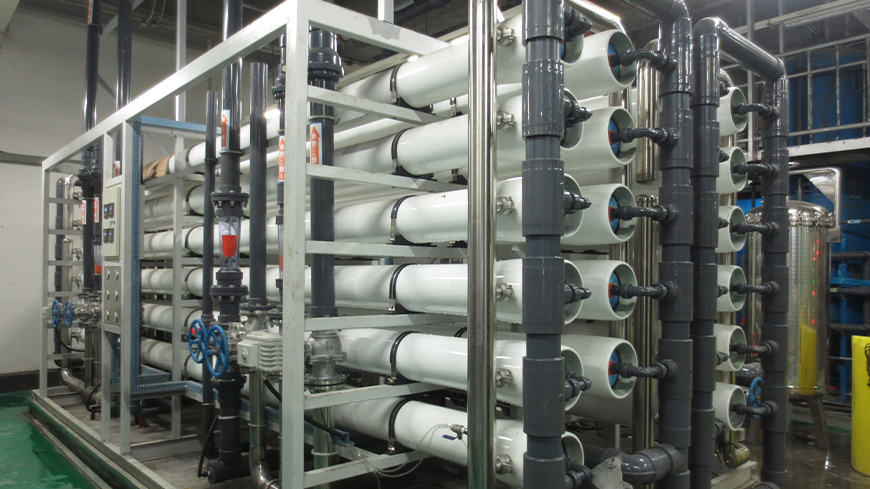
Water can be treated to remove materials. It can also be treated in order to control mineral content and to prevent unwanted chemical reactions. Scale and rust can also cause damage.
Water is increasingly being recycled and reverse osmosis is being utilised to desalinate water. Cooling technology is also becoming more advanced. Therefore, the choice of chemicals for water treatment is of even greater importance.
HMDTMPA is a phosphonate and has the full name Hexamethylenediamine tetra(methylenephosphonic) acid. It can be used as a scale inhibitor and for water treatment.
It may also be referred to as HDTMP. HMDTMPA is an aminophosphonate and contains 4 acid groups. It is therefore able to interact with metal ions and mineral crystal structures.
HMDTMPA is effective at inhibiting calcium sulphate and barium sulphate scale. Furthermore, the potassium salt is sometimes used in membrane and desalination water treatment.
Alongside scale inhibition, there is also interest in investigating the chemistry of HMDTMPA and its effect on carbon steel rust and its rate of rusting within the chemical industry.
An appreciation of what HMDTMPA is made up of and of its behaviour and mode of action can be of benefit to both the water treatment and chemical industries when choosing suitable chemicals.
What is HMDTMPA?
Hexamethylenediamine tetra(methylenephosphonic) acid (HMDTMPA) is a phosphorus containing chemical. It belongs to the aminophosphonate group.
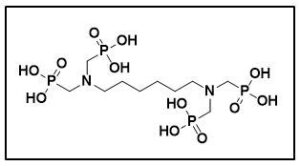
The core of this molecule is hexamethylenediamine. Four methylene acid groups are attached to this.
This enables HMDTMPA to interact with metal ions and mineral crystal structures.
HMDTMPA can be used in mineral precipitation control products. It can also be used as a scale inhibitor and for metal ion control.
Usually the parent form of HMDTMPA is a white solid. Some neutralised salts are also produced and sold as chemical products.
Other Names for HMDTMPA
Within the specialty chemical industry, HMDTMPA can be known by and given various alternative names.
- HDTMP
- HMDTMP
- HDTMPA
- HMDTMP Acid
- Hexamethylenediamine tetra(methylenephosphonic) acid
- Hexamethylenediaminetetrakis(methylenephosphonic acid)
- Hexamethylene Diamine Tetra (Methylene Phosphonic Acid)
- Hexa Methylene Diamine Tetra Phosphonic Acid
Companies may also use their own names. Therefore, it is important that the industry verifies the identity, CAS number and physical state of any chemical product.
Chemical Information and Properties
It is important to understand the chemical in question in order to purchase, formulate and utilise it.
| Chemical Parameter | Information |
| Common Name | HMDTMPA |
| Alternate Name | HDTMP |
| Full Name | Hexamethylenediamine tetra(methylenephosphonic) acid |
| CAS Number | 23605-74-5 |
| Molecular Formula | C₁₀H₂₈N₂O₁₂P₄ |
| Molecular Weight | 492.3g/mol |
| Chemical Family | Aminophosphonates |
| Chemical Category | Organophosphonate |
| Phosphonic Acid Groups | 4 |
| Nitrogen Atoms | 2 |
| Typical Physical State of Parent Acid | White crystalline solid |
| Water Solubility of Parent Acid | Poor |
| Function | Scale inhibition and metal ion complexation. |
| Available Forms | Parent and selected neutralised salts. |
Note – The information provided relates to the parent acid and is not necessarily applicable to all forms of this material.
Formulations can have differing compositions, densities, pH values and physical states. Levels of impurities may also vary.
Always examine the Technical Data Sheet, Safety Data Sheet and Certificate of Analysis of chemical products provided by manufacturers.
Understanding the Chemistry of Hexamethylene Diamine Tetra
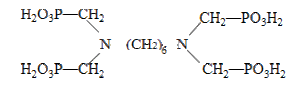
The structure of Hexamethylene Diamine Tetra (Methylene Phosphonic Acid) influences its behaviour.
Unlike phosphate compounds, HMDTMPA contains carbon-phosphorus bonds and is based upon an organic molecule.
It can be simplified to have the following structure:
[(HO) 2P (=O)–CH₂] 2N – (CH₂) 6 – N[CH₂ – P (=O)(OH) 2] 2
Important structural aspects are as follows.
Hexamethylenediamine Core
This is a 6 carbon chain which joins together two nitrogen atoms.
It provides a structure to maintain a distance between these two nitrogen centres.
The length and shape of this chain will influence the molecule’s flexibility and its interaction with other chemical species.
Phosphonic Acid Groups
There are 4 phosphonic acid groups on HMDTMPA.
Depending on the chemical environment, these can become ionised.
Together with the nitrogen centres, these are involved in the interaction of HMDTMPA with metal ions and mineral crystal structures. This is partly how HMDTMPA inhibits mineral scale.
Nitrogen Centres
As part of the aminophosphonate structure, there are two nitrogen centres.
Together with the phosphonic acid groups, they can influence metal ion interaction.
Carbon-Phosphorus Bonds
This is a key feature of HMDTMPA, distinguishing it from normal organic phosphate esters.
It also contributes to the stability of HMDTMPA’s
Nevertheless, HMDTMPA does not necessarily exhibit inert behaviour in chemical, thermal and environmental contexts.
Multi-site Interaction
HMDTMPA can interact with a variety of chemical species. This may include:
- Calcium ions.
- Magnesium ions.
- Selected transition metal ions.
- Mineral crystal growth.
- Metallic surfaces.
- Inorganic suspended solids.
The nature and extent of interaction will depend on both water chemistry and application conditions.
Important Chemical Properties of HMDTMPA
HMDTMPA has properties which make it suitable for utilisation in water treatment.
1. Mineral Scale Inhibition
HMDTMPA can interfere with the nucleation and growth of selected mineral crystals.
It is particularly suitable for use in products designed for the control of calcium sulphate and barium sulphate scale.
Performance will be influenced by mineral saturation, inhibitor concentration and application conditions.
2. Metal Ion Complexation
The acid groups on HMDTMPA can interact with metal ions in solution.
This may in turn influence the behaviour and availability of metal ions within a water treatment system.
Performance will depend on the pH, competing ions and chemistry.
3. Poor Water Solubility of Parent Acid
The parent HMDTMPA acid has poor water solubility.
This should be recognised when formulating chemical products.
Where good water solubility is required, neutralised salt forms can be selected.
4. pH Influenced Ionisation
pH can influence the ionisation of HMDTMPA’s acid groups.
This in turn will affect the charge of HMDTMPA and its interaction with both soluble ions and mineral crystal structures.
Therefore, HMDTMPA may behave differently in alkaline conditions.
5. Crystal Growth Modification
HMDTMPA can interact with selected sites on mineral crystal structures.
Such interaction may slow crystal growth and/or alter crystal shape.
This is important in industrial scale control.
6. Thermal Properties
Chemical products based on HMDTMPA are applicable to some high temperature applications.
Thermal stability should be compared with both the operating temperature and the length of time for which the product is used.
7. Surface Adsorption
Chemicals with acid groups can adsorb onto metallic surfaces.
This is important for both mineral scale control and for surface chemistry investigation.
8. Chemical Compatibility
HMDTMPA may be used in chemical products which also include further water treatment chemicals.
Investigation should be undertaken into its compatibility with dispersant polymers, corrosion inhibitors, oxidising agents and other constituents.
9. Salt Formation
HMDTMPA can form salts, with neutralisation of its phosphonic acid groups.
Particularly the potassium salts are of value in some water treatment applications.
Why is HMDTMPA Considered a Specialist Phosphonate?
Phosphonates can behave in particular ways due to their structure, functional groups and interaction with soluble minerals.
Whilst HMDTMPA is a phosphonate, its structure comprises a lengthy organic core and a number of phosphonic acid groups. This renders it particularly appropriate for scale control and less so for general application.
Important Characteristics of HMDTMPA
- Contains 4 phosphonic acid groups.
- Has a hexamethylenediamine core.
- Can interact with selected metal ions in solution.
- Is suitable for sulphate scale control.
- Can modify mineral crystal growth.
- Is available in selected neutralised salt forms.
- Can be investigated for application in water treatment.
- Is suitable for use in chemical products for industrial desalination.
- May be of value in surface adsorption and rust investigation.
Although HMDTMPA is a specialist phosphonate, this does not necessarily make it superior to other phosphonates. Appropriate application will depend on the target mineral scale, water chemistry and application requirements.
Understandings of Mineral Scale Formation within Industry
Often, water will contain dissolved minerals.
Alterations in water chemistry, temperature, pressure and/or mineral content can cause the water to become supersaturated.
Nucleation then occurs. Crystals can then develop.
Over time, these can accumulate on equipment and form scale.
Common Causes of Mineral Scale Formation
- High calcium hardness.
- High sulphate content.
- Alteration in water pH.
- Increased water temperature.
- High solids content.
- Water evaporation.
- Increased membrane recovery.
- Water mixing.
- Change in pressure.
- Poor water treatment.
- Inappropriate application conditions.
As mineral scale will differ from plant to plant, it is important to identify the actual type of scale so that suitable chemical products can be chosen.
Types of Mineral Scale and their Relevance to HMDTMPA
There are different types of mineral scale. Each has distinct chemical characteristics and modes of scale formation.
| Mineral Scale | Chemical Formula | Typical Industrial Application |
| Calcium Sulphate | CaSO₄ | Desalination, cooling water and industrial water concentration. |
| Barium Sulphate | BaSO₄ | Oilfield and sulphate industrial waters. |
| Calcium Carbonate | CaCO₃ | Cooling towers, heat exchangers and hard water systems. |
| Strontium Sulphate | SrSO₄ | Some oilfield and industrial waters. |
| Calcium Phosphate | Various calcium phosphate phases | Calcium rich systems with phosphate. |
| Iron Oxide Scale | Various iron oxide phases | Systems containing corrosion products. |
| Silica Scale | SiO₂ and associated silicate phases | Membrane and concentrated industrial waters. |
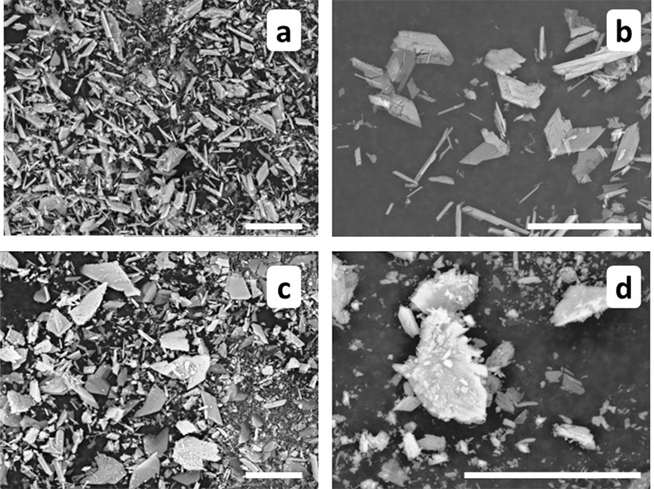
HMDTMPA is highly suitable for controlling calcium sulphate and barium sulphate scale. Other mineral scales may require specific chemical or methods of control.
Iron oxide scale can originate both from rust and from the settling out of particles. Unlike typically mineral scale formation, it is not necessarily derived from mineral scale formation.
How Does HMDTMPA Act as a Scale Inhibitor?
HMDTMPA interacts with ions and mineral crystal structures and so can influence mineral precipitation.
Scale inhibition can be analysed in 6 stages.
Stage 1 Minerals are Dissolved
Industrial feed water may contain calcium, barium and sulphate, amongst other, dissolved ions.
Until particular conditions are met, these ions can remain in solution.
Stage 2 Mineral Concentration Rises
Water can evaporate. Water can also be separated out by membranes. Water chemistry can also change. All of these can result in an increase in mineral concentration. Eventually a system may become supersaturated with respect to the minerals it contains.
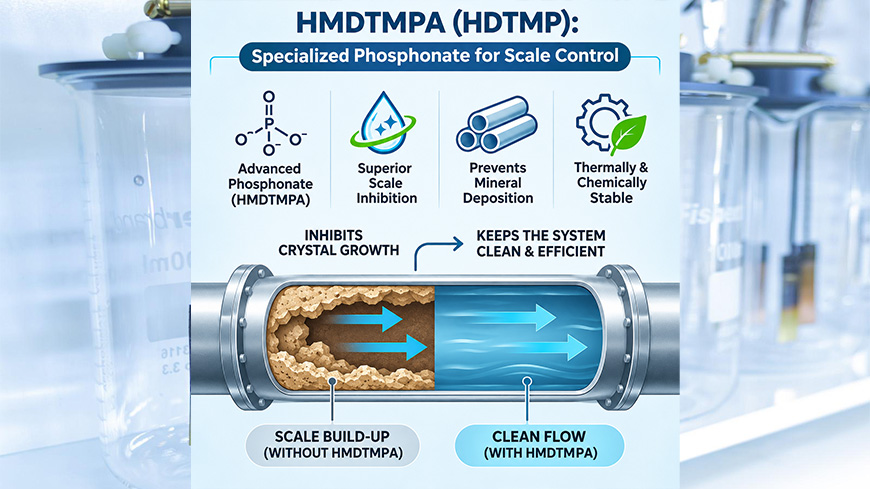 Stage 3 Mineral Seed Formation
Under prevailing conditions, dissolved ions can combine together to produce small mineral clusters. Some of these can then develop into seed crystal structures.
Stage 4 HMDTMPA Binds to Crystal Structures
HMDTMPA molecules can adhere to active sites on mineral crystal structures. Once bound, they may prevent mineral ions from attaching to crystal structures.
Stage 5 Crystal Growth is Modified
Scale inhibitors can slow crystal growth. They can also modify it. This can reduce mineral precipitation and so limit scale formation.
Stage 6 Scale Formation is Restricted
Where inhibitors are incorporated in an application, reduced mineral deposition can allow equipment to function optimally. It should be recognised that scale inhibitors do not actually remove minerals from water. Additional water treatment steps may be necessary to manage suspended solids, corrosion by-products and existing deposits.
Threshold Inhibition and Crystal Growth Modification
Threshold inhibition is a method of scale inhibition. Certain chemicals can inhibit mineral precipitation even at concentrations too low to bind to all of the dissolved mineral ions. This is of particular relevance for systems with high salt content. Threshold inhibition can be achieved using HMDTMPA within chemical applications.
Threshold Inhibition
Threshold inhibition occurs during mineral nucleation and crystal growth. It aims to either delay or reduce mineral precipitation.
Crystal Growth Modification
Scale inhibitors may adsorb to mineral crystal structures. They can then modify crystal growth. This can in turn affect crystal shape and deposition.
Metal Ion Complexation
HMDTMPA can interact with metal ions in solution. This can influence metal ion behaviour.
Dispersion
Dispersion is the process of preventing suspended solids from settling out or depositing on equipment. Alongside chemicals, suitable dispersant polymers may also be required.
| Mechanism | Function | Industrial Application |
| Threshold Inhibition | Prevents mineral precipitation | Scale inhibition |
| Crystal Growth Modification | Modifies crystal growth | Reduces undesirable mineral scale deposition |
| Metal Ion Complexation | Binds to metal ions | Controls metal ion behaviour |
| Dispersion | Disperses particles | Reduces particle deposition |
Such mechanisms can be used by industry to formulate well balanced water treatment products.
What is HMDTMPA Potassium Salt?
HMDTMPA potassium salt is a neutralised version of Hexamethylenediamine tetra(methylenephosphonic) acid. Neutralisation introduces potassium counter-ions into the chemical structure. This can affect properties such as water solubility and pH. Frequently, the hexapotassium salt is used; this is often abbreviated to HMDTMPA·K₆ or K₆HDTMP. It is well suited for water treatment applications where an improved water solubility and formulation compatibility are required.
Chemical Information for HMDTMPA Potassium Salt
| Chemical Parameter | Information |
| Chemical Name | Potassium salt of Hexamethylenediamine tetra(methylenephosphonic) acid |
| Common Abbreviation | HMDTMPA·K₆ |
| Alternative Name | K₆HDTMP |
| CAS Number (Potassium Salt) | 38820-59-6 |
| CAS Number (Hexapotassium Salt) | 53473-28-2 |
| Molecular Formula (Hexapotassium Salt) | C₁₀H₂₂N₂O₁₂P₄K₆ |
| Molecular Weight (Hexapotassium Salt) | 721g/mol |
| Water Solubility | Water |
| Typical Physical State | Water based liquid |
| Main Application | Industrial mineral scale inhibition |
Commercially, HMDTMPA potassium salt products can vary in the extent of neutralisation and in their active acid and salt content, as well as in other product properties.
HMDTMPA Acid and HMDTMPA Potassium Salt
Both HMDTMPA acid and potassium salt are derived from the parent phosphonate structure. However, they behave differently in formulations.
| Parameter | HMDTMPA Acid | HMDTMPA Potassium Salt |
| Chemical Type | Parent phosphonic acid | Neutralised potassium salt |
| Typical Physical State | Crystalline solid | Usually sold as a water based liquid |
| Water Solubility | Poor | Water solubility |
| Molecular Formula | C₁₀H₂₈N₂O₁₂P₄ | C₁₀H₂₂N₂O₁₂P₄K₆ (hexapotassium salt) |
| Molecular Weight | 492.3g/mol | Approximately 721g/mol (hexapotassium salt) |
| pH | Acidic | Depends on neutralisation level and formulation |
| Formulation Compatibility | Needs to be verified for water solubility | Can be suitable for some water based formulations |
| Typical Applications | Specialty chemical products | Selected reverse osmosis and industrial water treatment products |
| Active Content | Varies with grade | Varies with grade |
Industry should investigate which physical state is most appropriate for a given application. Neither the parent acid nor the potassium salt should be assumed to be interchangeable on a weight for weight basis.
HMDTMPA Potassium Salt in Reverse Osmosis
Reverse osmosis is widely used to separate water from salts and other materials. When water is processed using a membrane, clean water passes through and dissolved minerals become enriched within the reject stream. As mineral concentration increases, so too may conditions which favour scale formation. HMDTMPA potassium salt is included in reverse osmosis antiscalant products. This enables mineral precipitation to be controlled within membrane water treatment systems. The increased water solubility of the potassium salt can also render it a good formulation option.
Why Scale Inhibition is Important within Reverse Osmosis
Mineral scale can form on membranes and within feed channels. This can adversely affect the efficiency and reliability of the desalination process. Potential issues include:
- Reduced permeate production.
- Increased membrane pressure requirements.
- Increased differential pressure.
- Greater energy consumption.
- Increased frequency of cleaning.
- Reduced membrane performance.
- System downtime.
- Premature membrane replacement.
Good pre-treatment and selection of appropriate antiscalant can help to alleviate these issues.
Functions of HMDTMPA Potassium Salt in Reverse Osmosis Formulations
- Prevent calcium sulphate precipitation.
- Modify mineral crystal growth.
- Support sulphate scale control strategies.
- Facilitate formulation of water based antiscalant products.
- Enable control of mineral scale under prevailing conditions.
Prior to incorporating HMDTMPA potassium salt into a reverse osmosis system, it is important to investigate membrane compatibility, feed water chemistry, product quality and relevant legislation. Not all commercial HMDTMPA potassium salt products are permitted for use in, for example, drinking water or in membranes.
Reverse Osmosis Desalination Scale Inhibitor
Reverse Osmosis Desalination Scale Inhibitor is a chemical product which has been developed to prevent and inhibit mineral scale formation. Whilst reverse osmosis is not capable of resolving mineral saturation issues,. It can be used to separate water from dissolved salts and to enrich the salts within a reduced volume of water. Without adequate scale inhibition, as mineral concentration increases so can the likelihood of minerals precipitating.
Common Mineral Scale Issues within Reverse Osmosis Desalination
Reverse osmosis can be affected by a variety of mineral scales.
Calcium Carbonate Scale
Factors such as calcium content, alkalinity and pH, as well as temperature, can all influence the precipitation of calcium carbonate.
Calcium Sulphate Scale
As calcium and sulphate contents increase beyond the saturation level for minerals, calcium sulphate can present a problem.
Barium Sulphate Scale
As barium sulphate is partially soluble, it can be difficult to control its formation if both barium and sulphate are present.
Strontium Sulphate Scale
Strontium sulphate can form in feed and desalination waters.
Silica Scale
Formation of silica scale is influenced by water chemistry. Specific control strategies may be necessary. Do not assume that a sulphate scale inhibitor will also be effective against silica scale.
Choosing a Reverse Osmosis Desalination Scale Inhibitor
- Feed water analysis should be examined.
- Calcium and magnesium content.
- Sulphate content.
- Barium and strontium levels.
- Silica content.
- Water pH.
- Water temperature.
- Membrane recovery.
- Membrane manufacturer’s requirements.
- Antiscalant compatibility.
- Concentrate discharge legislation.
- As appropriate, drinking water use approval.
An effective reverse osmosis scale control strategy must be based on water conditions not simply on a chemical product’s name.
Effects of Reverse Osmosis Recovery on Scale Formation
Reverse osmosis system design incorporates consideration of the recovery rate. This is the proportion of feed water converted into permeate. As recovery increases so does the concentration of dissolved salts in the reject stream. Broadly, the concentration factor can be approximated as:
Concentration Factor = 1 / (1 – Recovery Fraction)
This equation assumes complete salt rejection (100%) and does not account for mineral precipitation or localised concentration effects.
| Reverse Osmosis Recovery | Approximate Concentration Factor |
| 50% | 2 times |
| 60% | 2.5 times |
| 70% | 3.33 times |
| 75% | 4 times |
| 80% | 5 times |
| 85% | 6.67 times |
| 90% | 10 times |
Example of Mineral Concentration
If feed water has a calcium content of 200mg/L and sulphate content of 300mg/L and a water recovery rate of 75%, then the approximate concentration factor is 4. Assuming that:
- The calcium content of the reject stream is approximately 800mg/L.
- And that sulphate content of the reject stream is around 1200mg/L.
This illustrates how mineral concentration can increase as a result of membrane processing. However, it does not confirm whether or not mineral precipitation will occur. Nor does it determine the correct antiscalant dosage. Real world reverse osmosis system design must take into account mineral saturation, ionic activity, membrane rejection and concentration polarisation, as well as application conditions. Within an effective scale control strategy, HMDTMPA based products can be investigated for use in situations where there is concern that sulphate minerals will precipitate.
Application of HMDTMPA for Calcium Sulphate Scale Control
Calcium sulphate is a mineral which can form scale within industrial water treatment systems. It can exist in a number of mineral forms, such as gypsum, hemihydrate and anhydrite. Factors such as temperature, calcium and sulphate content and overall water chemistry will all impact on calcium sulphate precipitation behaviour.
Difficulties in Controlling Calcium Sulphate Scale
Whilst for some carbonate scale issues pH can effectively be manipulated to control scale formation, this is not always the case for calcium sulphate. Indeed, as water concentration increases, so can the likelihood of calcium sulphate precipitation. Consequences may comprise:
- Membrane scale formation.
- Restricted equipment flow.
- Impeded heat transfer.
- Increased maintenance requirements.
- Pressure drop across equipment.
- Reduced process efficiency.
Role of HMDTMPA
HMDTMPA can adsorb to mineral crystal structures. It can therefore alter mineral precipitation behaviour. Laboratory and application testing should be conducted to establish whether
HMDTMPA can adhere to mineral crystals. This can then effect precipitation.
HMDTMPA and Barium Sulphate Scale Control
Barium sulphate is another mineral and can also produce scale in certain situations.
Ment programme
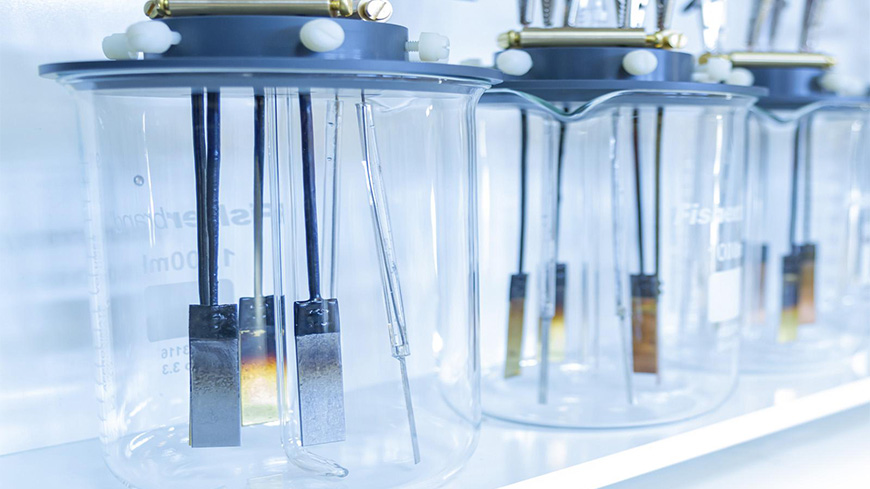
Test the corrosion resistance of a metal.
Field Trial
Following laboratory testing, field trials should also be carried out to confirm laboratory findings.
How Is Carbon Steel Corrosion Inhibition Evaluated?
Industrial researchers and water treatment specialists use several techniques to evaluate corrosion inhibitors.
1. Weight Loss Testing
Carbon steel coupons are exposed to a controlled environment for a specified period.
The difference in mass before and after exposure can help determine corrosion-related metal loss.
2. Electrochemical Impedance Spectroscopy
Electrochemical Impedance Spectroscopy, or EIS, is used to examine electrochemical behaviour at the metal–solution interface.
It can provide information about charge transfer behaviour and protective surface characteristics.
3. Potentiodynamic Polarisation
Polarisation measurements help evaluate how treatment chemicals influence electrochemical corrosion reactions.
4. Scanning Electron Microscopy
Scanning Electron Microscopy, commonly known as SEM, allows researchers to examine metal surface morphology after exposure.
5. Energy Dispersive X-Ray Spectroscopy
EDS can help identify elemental composition within selected regions of an exposed metal surface.
6. Surface Spectroscopy
Techniques such as X-ray photoelectron spectroscopy may be used to investigate surface chemical composition and interactions.
Evaluating Corrosion Inhibition Efficiency
When comparable corrosion rates are available, inhibition efficiency may be calculated using the following expression:
Corrosion Inhibition Efficiency (%) = [(CR₀ − CRᵢ) ÷ CR₀] × 100
Where:
- CR₀ represents the corrosion rate without the inhibitor.
- CRᵢ represents the corrosion rate in the presence of the inhibitor.
The calculation requires comparable testing conditions.
HMDTMPA-specific corrosion performance should be supported by experimental data rather than inferred solely from phosphonate molecular structure.
Common RO Scale Issues and Solutions
There are various reasons why a reverse osmosis system may not function as intended.
Therefore it is important to determine the source of any such issues prior to modifying a scale inhibition programme.
| Issue | Cause | Action |
| Reduced permeate flow | Mineral and/or membrane fouling. | Investigate membranes and fouling. |
| Increased differential pressure | Fouling and/or suspended solids. | Investigate the feed channel and pre-treatment process. |
| Calcium sulphate scale | High calcium and sulphate levels. | Investigate mineral saturation. Ensure that the scale inhibitor is appropriate for the situation. |
| Barium sulphate scale | Barium and sulphate levels are too high and precipitate. | Investigate the water chemistry. Investigate specialist scale inhibition. |
| Calcium carbonate scale | High carbonate levels. | Investigate pH, alkalinity and calcium levels. |
| Silica scale | High levels of silica. | Investigate silica targeted treatment options. |
| Regular membrane cleaning | Inappropriate pre-treatment and/or chemical. | Investigate the whole treatment programme. |
| Inconsistent antiscalant performance | Feed water quality varies. | Regularly test water chemistry. |
| Chemical precipitation | Poor chemical formulation compatibility. | Investigate chemical compatibility. |
| Increased running costs | Membrane and/or equipment performance. | Investigate membrane and equipment normalised performance and maintenance requirements. |
Simply increasing chemical volumes may not resolve an issue if the underlying source is not investigated.
Understanding Acid and Salt Active Ingredient Contents
When purchasing HMDTMPA potassium salt, it is important to appreciate the difference between the acid and salt Active Ingredient contents.
Neutralisation causes potassium counter-ions to bind to a chemical. Therefore, the weight of a chemical will depend on whether it is purchased as the parent acid or potassium salt.
For the hexapotassium salt:
Acid Equivalent Fraction = (Molecular Weight of Parent Acid) / (Molecular Weight of Hexapotassium Salt)
Molecular weights can be used to calculate this fraction:
492.3/721 = 0.683
Therefore, in theory 1kg of pure hexapotassium salt is equivalent to 0.683kg of parent acid.
Therefore, in a hypothetical aqueous product containing 33% pure hexapotassium salt, this would equate to 22.5% parent acid.
Such calculations are useful. It is important to investigate the analytical and formulation methods that are used by manufacturers.
Failure to investigate the methodology for determining acid and salt Active Ingredient contents can affect purchasing decisions.
Selecting an Appropriate HMDTMP Acid Supplier
An appropriate HMDTMP Acid Supplier should be able to provide industrial customers with products that fulfil both business and technical requirements.
Whilst cost is an important consideration, there are a number of factors that should be considered when selecting a supplier.
Information to Obtain from an HMDTMP Acid Supplier
- What is the CAS number?
- Does it contain parent acid or potassium salt?
- What is the Active Ingredient content?
- Is this expressed as an acid or salt content?
- What are the levels of impurities?
- Can you obtain a Certificate of Analysis for a batch?
- How should the product be stored?
- What packaging is available?
- Is the product appropriate for your application?
- What information can you obtain?
- Can the supplier provide technical support?
All of the above are important areas for investigation.
Environmental Aspects of HMDTMPA
In addition to assessing the efficiency of water treatment, good water management also considers the environmental impact of operations.
As a phosphorous containing chemical, there are environmental aspects of HMDTMPA that should be investigated in order to ensure that it is appropriate for a given application.
Environmental Longevity
Under test conditions, certain phosphonates can demonstrate slow degradation.
Both a chemical’s structure and the environment will influence its environmental behaviour.
Adsorption
Phosphonates can adsorb to surfaces, particles and sediments.
Adsorption can in turn impact on a chemical’s environmental dispersion.
Phosphorous Discharge
Water containing HMDTMPA contains phosphonate compounds which are discharged into wastewater.
Businesses should investigate relevant discharge legislation.
Wastewater Treatment Compatibility
Industrial businesses should consider how phosphonate containing wastewater interacts with their existing wastewater treatment process.
RO Reject Stream
During reverse osmosis, solutes (both mineral and chemical) become more concentrated within the reject stream.
Chemical composition and relevant discharge legislation should both be considered when managing this stream.
Responsible Chemical Usage
Good chemical treatment can also aid responsible chemical usage.
HMDTMPA should not be described as either ‘biodegradable’ or ‘environmentally friendly’ unless there is evidence to support such claims.
The Future of HMDTMPA in Industrial Water Treatment
Businesses are keen to both re-use water and to use chemicals in a responsible manner. As a result, industrial water management is continually evolving.
Specialty chemicals such as HMDTMPA continue to play an important role within this development.
Water Re-Use
Mineral levels can increase during water re-use. This can then lead to new scale issues.
Chemical selection will continue to be an important area for addressing such issues.
Improved Desalination Technology
Reverse osmosis and other membrane technologies continue to be used for both producing and treating water within industry.
Membrane performance is greatly influenced by scale inhibition.
Future Chemical Formulations
Future chemical formulations may incorporate phosphonates, dispersant polymers and other chemicals to address water related issues.
Carbon Steel Surface Chemistry
Investigation into how carbon steel surfaces absorb chemicals and inhibit rust can yield valuable information. This in turn provides insights into phosphonate molecule-metal surface interaction.
Digital Water and Treatment Monitoring
Continuous monitoring of both water and equipment can enable businesses to identify emerging scale issues at an early stage. Action can then be taken to avoid these developing into operational concerns.
Responsible Water Treatment
Future water treatment strategies will need to further balance good chemical performance, resource efficiency and legal compliance.
Therefore, consideration should be given to HMDTMPA and other phosphonates in this context.
Conclusion
HMDTMPA (or Hexamethylenediamine tetra(methylenephosphonic) acid) is a phosphonate. It is valuable for industrial water and mineral scale control.
HMDTMPA has four acid groups attached to a hexamethylenediamine backbone. This enables it to interact with dissolved metal ions and mineral crystal growth.
HMDTMPA can be utilised for a variety of purposes. For example, it can be used for calcium sulphate and barium sulphate scale inhibition. It can also be used within reverse osmosis desalination and industrial process water treatment.
Furthermore, HMDTMPA Potassium Salt can be utilised by formulators for certain membrane water treatment applications where improved water solubility is required.
Investigation into carbon steel surface adsorption and corrosion inhibition also illustrates the importance of understanding phosphonate molecule-metal surface interaction.
Ultimately, product efficacy is influenced by water chemistry, product quality, chemical compatibility and demonstrated operational performance.
Selecting an appropriate HMDTMP Acid Manufacturer and Supplier can therefore support industrial customers in identifying suitable, well-supported chemical products.
If you require guidance on scale control chemicals for your plant please contact Maxwell Additives. Alongside chemical information, we can discuss your plant’s scale control requirements. We can then assist you in identifying suitable specialty chemicals for your water treatment requirements.
Commonly Asked Questions
1. What is HMDTMPA?
Hexamethylenediamine tetra(methylenephosphonic) acid is an aminophosphonate. It is used within some -scale and specialty chemicals.
2. What does HDTMP stand for?
Hexamethylenediamine tetra(methylenephosphonic) acid. It is also frequently referred to as HMDTMPA.
3. What is the CAS number for HMDTMPA?
The parent acid has a CAS number of 23605-74-5.
4. What is the molecular formula for HMDTMPA?
The molecular formula for the parent acid is C₁₀H₂₈N₂O₁₂P₄.
5. What is the molecular weight for HMDTMPA?
The molecular weight for the parent HMDTMPA acid is 492.3g/mol.
6. Is HDTMP equivalent to HMDTMPA?
Generally speaking, yes. Both terms refer to the parent phosphonate. However, it is important to investigate the chemical and product type prior to purchasing.
7. What are HMDTMPA used for?
HMDTMPA is utilised for -scale inhibition, metal ion chelation, oil field water treatment and for specialty chemicals.
8. Is HMDTMPA water soluble?
To some extent, yes. Some potassium salts are readily water soluble.
9. What is HMDTMPA potassium salt?
This is the neutralised form of the parent phosphonic acid. Commonly, the hexapotassium salt is represented as HMDTMPA·K₆.
10. Can HMDTMPA potassium salt be used in RO?
Some HMDTMPA potassium salt formulations can be tested to assess their -scale properties within osmosis systems. Membrane compatibility, feed water chemistry and relevant legislation should all be considered.
11. What is an RO Desalination Anti-Scale Chemical?
This is a formulation designed to disperse minerals so that scale is not formed within a reverse osmosis desalination system.
12. Is HMDTMPA effective against calcium sulphate scale?
Yes. HMDTMPA is particularly well suited to calcium sulphate scale inhibition. Performance will depend on the water chemistry and operating conditions.
13. Can HMDTMPA be used for Barium Sulphate Scale Control?
HMDTMPA can be tested for certain Barium Sulphate Scale Control applications. It is important to test its actual performance for your specific application.
14. Can HMDTMPA be used to remove mineral scale?
Typically, HMDTMPA is used for scale inhibition. Scale removal is generally achieved through a specifically tested cleaning process.
Related Posts