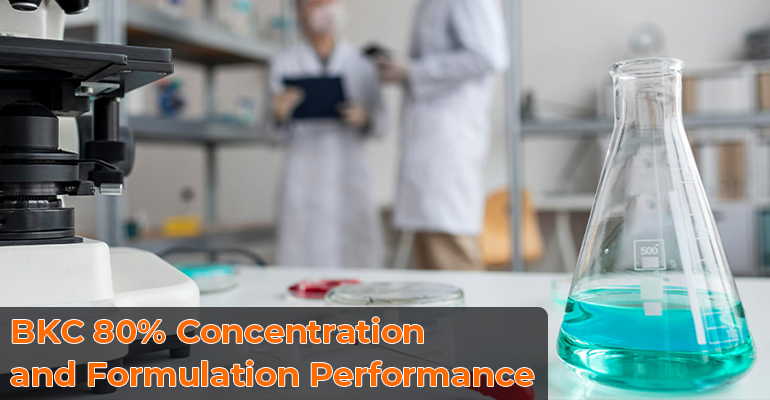
Benzalkonium Chloride Solution (BKC 80%) is a highly concentrated solution of Benzalkonium Chloride, which is a common ingredient for those products that need antibacterial effects and cationic surfactants. According to Maxwell Additives, their BKC 80% product is an Alkyl Dimethyl Benzyl Ammonium Chloride with predominance of C12–C14 chains and about 80% of active substance...
Benzalkonium Chloride BKC 80%: Uses, Features and Benefits
 What is Benzalkonium Chloride BKC 80%?
BKC 80% is a concentrated form of Benzalkonium Chloride, a quaternary ammonium compound used in industrial formulations where microbial control and surface-active performance are important. It is commonly supplied as a liquid raw material and contains a high proportion of active Benzalkonium Chloride, making it suitable for manufacturers that need a concentrated ingredient for further formulation.
Benzalkonium Chloride – BKC 80% can be used in different industrial and commercial applications, including cleaning formulations, textile treatment, selected water-system applications, preservation systems, and specialty chemical products. Its cationic nature gives it the ability to interact with microbial cell surfaces, while its surfactant characteristics can support wetting and surface interaction in suitable formulations.
The practical value of BKC 80 comes from its concentration and versatility. Instead of using a lower-strength solution as the starting material, formulators can work with a concentrated grade and develop the final product according to their required active level. The exact concentration, dosage, compatibility, and application should always be established through formulation testing and the applicable safety and regulatory requirements.
For industrial buyers, selecting a dependable BKC 80 Manufacturer is also important. Consistency in active content, physical properties, packaging, documentation, and batch-to-batch quality can directly influence the reliability of the finished product.
Why BKC 80% Is Useful for Industrial Formulators
Industrial manufacturing frequently requires chemicals that can perform consistently while fitting into existing production processes. A concentrated Benzalkonium Chloride grade can provide flexibility to companies developing cleaning, hygiene, preservation, and specialty formulations.
The higher active content can be particularly useful for manufacturers that prepare products at different strengths. Instead of maintaining several low-concentration raw materials, a concentrated input can be evaluated as a common starting point for multiple formulations.
At the same time, concentration alone does not determine performance. Factors such as pH, water quality, contact time, temperature, formulation composition, microbial load, and intended application can influence the final result. Manufacturers should therefore conduct application-specific trials rather than assuming that one dosage will work for every system.
This approach allows businesses to use Benzalkonium Chloride – BKC 80% more responsibly and efficiently while maintaining control over their finished-product specifications.
Features of Benzalkonium Chloride BKC 80%
1. High Active Concentration
BKC 80 provides a concentrated Benzalkonium Chloride base for industrial formulation work. Its high active content allows manufacturers to calculate the quantity needed for their target formulation more precisely. This can be useful for businesses producing products at different strengths, provided the final concentration is established through proper testing and formulation control.
2. Liquid Form for Practical Handling
BKC 80% is available as a liquid material, which can be convenient for manufacturers using liquid blending and dosing systems. The format allows controlled addition during production and can simplify the preparation of suitable formulations. Proper storage and handling procedures should always be followed according to the relevant technical documentation.
3. Cationic Surfactant Characteristics
The cationic nature of Benzalkonium Chloride gives BKC 80 useful surface-active characteristics in appropriate formulations. It can support wetting, spreading, and interaction with surfaces while also contributing antimicrobial functionality. Its behavior should be assessed with the complete formulation because ingredient compatibility can vary significantly between different chemical systems.
4. Broad Industrial Relevance
BKC 80 can be considered for several industrial applications rather than being limited to one product category. Manufacturers may evaluate it in cleaning, textile, preservation, water-related, and specialty chemical formulations. The actual suitability depends on the application objective, formulation composition, regulatory requirements, and performance testing conducted by the end user.
5. Water Compatibility
The supplied BKC 80 grade can be incorporated into suitable water-based formulations, which makes it relevant to many industrial products. Its behavior in a particular formulation can still depend on water quality and other ingredients. Manufacturers should therefore verify clarity, stability, compatibility, and final performance during laboratory and pilot-scale trials.
6. Useful for Concentration Adjustment
The concentrated nature of BKC 80 gives formulators flexibility when determining the active level of a finished product. It can be used as a starting material for controlled dilution where the application permits. Accurate calculations are essential because the required amount will depend on the target concentration and overall product design.
7. Suitable for Specialty Formulation Development
BKC 80 can be evaluated by manufacturers developing products where antimicrobial or cationic surfactant functionality is required. Its concentrated form provides a practical raw-material option for laboratory development and scale-up. Before commercial use, manufacturers should verify formulation stability, compatibility, performance, handling requirements, and the regulations applicable to their finished product.
Where Can BKC 80% Be Used?
BKC 80 has potential across several industrial sectors because of its antimicrobial and surface-active characteristics. The following applications should be considered as areas for technical evaluation rather than a universal indication that the material is appropriate for every product.
Industrial cleaning: BKC 80 can be incorporated into selected cleaning and hygiene formulations where microbial management is part of the product objective.
Textile processing: Textile manufacturers may evaluate BKC 80 in suitable treatment formulations designed to manage microbial contamination during processing or storage.
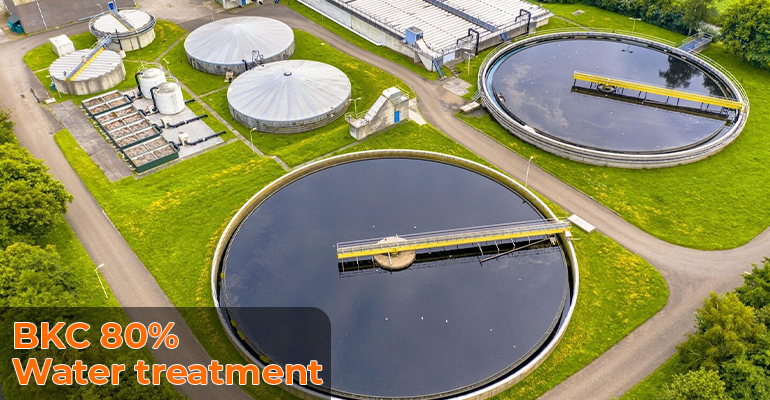
Water-system applications: Certain industrial water systems can require microbial-control strategies. BKC 80 may be evaluated as part of an appropriate treatment program under controlled operating conditions.
Paint and adhesive formulations: Water-based products can be vulnerable to microbial growth during storage. BKC 80 may be assessed as one component of a suitable preservation approach.
Pulp and paper processing: Microbial contamination can affect certain aqueous process streams and material quality. BKC 80 may be considered for applications where microbial management is technically appropriate.
Specialty chemical products: Formulators can investigate BKC 80 when developing selected disinfectant, hygiene, maintenance, or preservation products, subject to the relevant regulations and product claims.
What Should Buyers Check Before Purchasing BKC 80?
Buying a concentrated chemical should involve more than checking the price per kilogram. A manufacturer should first define the technical specification needed for the intended application.
Important points can include active content, appearance, density, pH, packaging, storage conditions, batch documentation, and delivery requirements. Buyers should also determine whether the supplier can maintain consistent quality across repeat orders.
For businesses searching for a BKC 80 % Manufacturer, technical communication is especially valuable. A supplier should be able to provide appropriate product information so that the buyer’s technical team can evaluate the material before introducing it into production.
It is also sensible to conduct a sample evaluation before committing to large-volume procurement. Laboratory testing can identify compatibility issues early and help manufacturers establish an appropriate formulation procedure.
For Indian businesses, working with a domestic supplier may additionally provide practical advantages in communication, delivery planning, and regular procurement, depending on the supplier’s manufacturing and distribution capabilities.
 Benefits of Benzalkonium Chloride BKC 80%
1. High-Concentration Formulation Base
One practical benefit of BKC 80% is its concentrated active content. Manufacturers can calculate the required quantity according to the desired concentration of the finished product. This can be useful for businesses developing different formulations from the same raw material while maintaining controlled dosing during production.
2. Supports Efficient Raw-Material Handling
The concentrated nature of BKC 80 can help manufacturers manage their raw-material requirements more efficiently. When the application requires a lower final concentration, the material can be incorporated according to a validated formulation. This provides production teams with flexibility while avoiding unnecessary handling of multiple concentration grades.
3. Versatile Industrial Application Potential
Benzalkonium Chloride can be evaluated across several industrial formulations where antimicrobial or cationic surfactant properties are required. Its potential applications include cleaning products, textile-related formulations, selected preservation systems, and process-treatment products. The actual suitability depends on formulation testing, intended use, and applicable regulations.
4. Useful Surface-Active Performance
Along with antimicrobial functionality, BKC 80 can provide surface-active characteristics in appropriate formulations. This can support wetting and interaction between the formulation and treated surfaces. Such properties can be valuable in products where cleaning or surface treatment is combined with microbial-control requirements.
5. Convenient for Product Development
A concentrated liquid raw material can give formulation teams greater freedom during product development. Researchers can evaluate different concentrations, ingredient combinations, and application conditions before selecting a final formula. This makes Benzalkonium Chloride – BKC 80% a practical option for manufacturers developing specialized chemical products.
6. Supports Consistent Production Planning
When a manufacturer works with a clearly specified BKC 80 grade, formulation calculations can be based on a defined active-content range. Consistent raw material can make production planning easier and help reduce unexpected variations between batches. Incoming quality checks should still be maintained as part of normal manufacturing control.
7. Suitable for Multiple Manufacturing Requirements
The versatility of BKC 80 allows different industries to investigate its use according to their individual requirements. Rather than being restricted to a single product category, it can be considered in several chemical formulations. This gives manufacturers an additional option when selecting raw materials for antimicrobial and surface-active applications.
BKC 80% vs. Lower-Concentration BKC: Which One Should You Choose?
The choice between BKC 80% and a lower-concentration Benzalkonium Chloride solution should be based on the manufacturing process rather than concentration alone.
A concentrated grade can be useful when the manufacturer wants to prepare different final concentrations internally. It may also reduce the amount of raw material required to deliver a particular active level. However, if a production line is already designed around a lower-strength solution, changing grades may require adjustments to dosing and mixing procedures.
For large-scale manufacturers, a concentrated material can provide greater formulation flexibility. For applications where a lower-strength solution is directly suited to the process, the simpler option may be more convenient.
The decision should therefore consider:
- Required active concentration
- Final product formulation
- Dosing equipment
- Storage capacity
- Transportation requirements
- Compatibility with other ingredients
- Production volume
- Supplier consistency
- Technical and regulatory requirements
There is no single concentration that is automatically ideal for every application. Proper formulation evaluation should determine the most suitable option.
Conclusion
Benzalkonium Chloride BKC 80% is a concentrated chemical raw material that can provide manufacturers with useful antimicrobial and cationic surfactant functionality. Its higher active concentration makes it suitable for formulation development where controlled dilution, efficient dosing, and flexible product design are important.
The real value of BKC 80 depends on how well it fits the complete formulation. Factors such as ingredient compatibility, water quality, concentration, processing conditions, storage, and the intended end use should all be considered before commercial application.
For businesses looking for a BKC 80 Manufacturer, product consistency should remain a major priority. Reviewing technical specifications, testing samples, checking batch documentation, and confirming long-term supply capability can help manufacturers make a more informed purchasing decision.
Frequently Asked Questions About BKC 80%
1. What is the main difference between BKC 80 and BKC 50?
The primary difference is the concentration of active Benzalkonium Chloride in the supplied material. BKC 80 is a more concentrated grade, while BKC 50 contains a lower active concentration. The appropriate option depends on the formulation, dosing method, production process, and required final concentration.
2. Is BKC 80 supplied as a liquid?
Yes, BKC 80 is supplied as a liquid Benzalkonium Chloride concentrate. Maxwell Additives’ current product information describes its BKC 80 grade as a liquid with an active content specification around 80%. Buyers should confirm the latest technical specification and certificate of analysis for their specific purchase.
3. Can BKC 80 be diluted for different applications?
A concentrated BKC 80 grade can be used as a starting material for suitable formulations where dilution is technically appropriate. However, the required concentration should not be selected only by calculation. Manufacturers should validate the finished formulation and follow the applicable safety, technical, and regulatory requirements.
4. What should I check before purchasing BKC 80?
Buyers should review active content, appearance, pH, density, packaging, storage recommendations, batch documentation, and supplier consistency. It is also useful to obtain a sample before bulk procurement. Testing the sample in the actual formulation can identify compatibility or performance issues before production begins.
5. Is BKC 80 compatible with other surfactants?
Compatibility depends on the particular formulation. BKC 80 is a cationic material, so manufacturers should not assume compatibility with every surfactant or additive. A laboratory compatibility study is recommended before commercial production, particularly when the formulation contains anionic ingredients or multiple active surface-active materials.
6. Where can I source BKC 80 in India?
Businesses can evaluate established specialty chemical manufacturers and suppliers based on their technical specifications, production consistency, documentation, packaging, and delivery capabilities. Maxwell Additives PVT LTD is one Indian specialty chemical company that lists Benzalkonium Chloride BKC 80 among its products. Buyers should review the latest product documentation before procurement.
7. Why is supplier consistency important for BKC 80?
Supplier consistency matters because changes in active content or other product characteristics can affect formulation calculations and finished-product performance. Maxwell Additives PVT LTD provides specifications for its BKC 80 grade, including active content, appearance, density, pH, solubility, and packaging information. Buyers should verify the latest batch documentation for every commercial requirement.
Related Posts