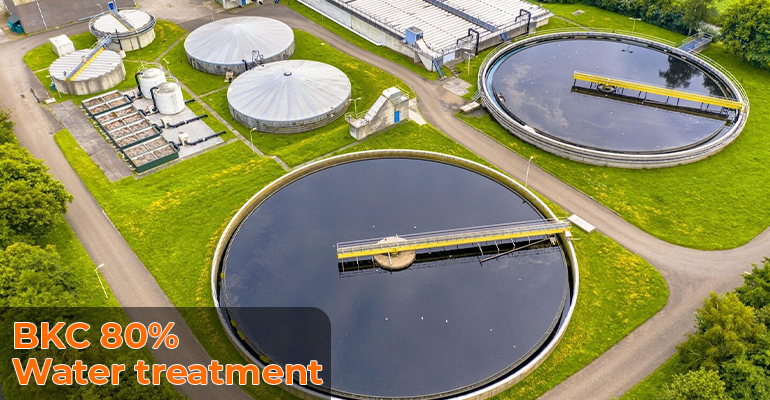

BKC 80 Chemical refers to a concentrated solution of Benzalkonium Chloride, a quaternary ammonium compound commonly known as a Quat. It is a cationic chemical that combines surface-active properties with antimicrobial functionality, making it useful in formulations where cleanliness, microbial control, and surface interaction are important. The “80” generally indicates the high active concentration of Benzalkonium Chloride in the supplied solution...
BKC 80%: Concentration and Formulation Performance

Benzalkonium Chloride Solution (BKC 80%) is a highly concentrated solution of Benzalkonium Chloride, which is a common ingredient for those products that need antibacterial effects and cationic surfactants. According to Maxwell Additives, their BKC 80% product is an Alkyl Dimethyl Benzyl Ammonium Chloride with predominance of C12–C14 chains and about 80% of active substance.
High concentration sets BKC 80% apart from the application of Benzalkonium Chloride as a pre-formulated disinfectant. Within the manufacturing industry, it functions as a concentrated ingredient for formulating, meaning that it is necessary to know the effect of concentration within the formula.
What is a BKC 80%?
BKC 80% is a concentrated form of Benzalkonium Chloride. This compound is a Quaternary Ammonium compound whose abbreviation is BKC. The chemical is provided in the form of a liquid. BKC 80% consists of 80% of Benzalkonium Chloride in terms of weight. 80% BKC provided by Maxwell Additives is formulated to consist of 80.0 ± 1.0% w/w of active matter.
Alkyl Dimethyl Benzyl Ammonium Chloride, or ADBAC, is an alternative name given to Benzalkonium Chloride. The substance possesses cationic characteristics and hence can act as surfactant. The substance is suitable for use in formulations that require microbial action. The chemical can be used in different industrial formulations based on the concentration and the environment conditions.
The 80% grade is particularly useful when a manufacturer wants a concentrated raw material rather than a lower-strength solution. The higher active content means that a smaller quantity of the concentrate can contribute a specified amount of Benzalkonium Chloride to a formulation. However, the finished product must still be evaluated at its actual use concentration.
This distinction is important. Benzalkonium Chloride BKC 80% in India may be supplied as a concentrated industrial raw material, while the final product manufactured from it may have a very different composition. The properties of the concentrate should therefore not automatically be treated as identical to those of the finished formulation.
BKC 80% and Concentration-Based Formulation Planning
The most useful way to understand BKC 80% is to look at how its concentration affects formulation decisions. When a manufacturer works with an 80% active raw material, the amount added to a batch has to be calculated according to the required active Benzalkonium Chloride level.
For example, if a formulation requires a specific amount of active BKC, the manufacturer needs to account for the fact that the starting material is an 80% concentrate rather than 100% active material. This allows the formulation team to calculate the appropriate quantity while also accounting for the water or carrier portion already present in the BKC solution.
This becomes important when producing large batches. Even a small calculation error can become significant when the same formulation is manufactured repeatedly at industrial scale. Accurate weighing, controlled addition, and batch documentation therefore become part of maintaining product consistency.
Dilution is another important consideration. BKC 80% can be used as a concentrated starting material, but once it is diluted, the surrounding chemical environment changes. The ratio of active material to water increases, and other ingredients may behave differently at the lower concentration.
A formulation developer should therefore evaluate the final diluted product rather than assuming that the characteristics of the concentrate automatically remain unchanged. Appearance, clarity, viscosity, stability, and compatibility can all be checked during development.
Water quality can also affect the formulation. Water containing different levels of minerals or dissolved substances may produce different results from highly controlled laboratory water. This is especially relevant when the finished product will be diluted at the point of use rather than during manufacturing.
Another factor is pH. Maxwell’s technical information gives a pH range around 6.0–8.0 for its BKC 80% product and a specification of approximately 7.5 ± 1. The final formulation, however, may have its own pH requirement depending on the other ingredients and intended application.
Concentration also affects handling. A concentrated chemical needs controlled dosing because adding too much at one point during blending can create a temporarily high local concentration. Proper mixing helps distribute the ingredient through the formulation.
For manufacturers, the key point is that BKC 80% provides flexibility, but that flexibility works best when active-content calculations, dilution, mixing, water quality, and final-product testing are considered together.
Features of BKC 80%
1. High Active Content
BKC 80% contains approximately 80% active Benzalkonium Chloride. This concentrated composition makes it suitable as a raw material for manufacturers that need to develop products with controlled final active concentrations.
2. Liquid Form
BKC 80% is supplied as a liquid, making it convenient for controlled addition to suitable formulations. Liquid handling can simplify weighing, blending, and dosing during industrial production.
3. Water Solubility
The product is described as soluble in water in all proportions. This characteristic supports its incorporation into aqueous formulations where uniform distribution of the active ingredient is required.
4. Cationic Character
Benzalkonium Chloride has cationic surfactant properties. This affects its interaction with other ingredients and makes charge compatibility an important consideration when designing a multi-component formulation.
5. Surface-Active Behavior
BKC can contribute surface-active characteristics alongside its antimicrobial function. This can be useful in products where wetting, spreading, or interaction with treated surfaces forms part of the formulation objective.
6. Broad Formulation Potential
BKC 80% can be considered for a variety of industrial applications, including detergents, textile treatments, paints, adhesives, wood preservation, paper processes, industrial water systems, and hard-surface applications.
7. Concentrated Starting Material
The 80% grade gives manufacturers a high-strength raw material from which different finished concentrations can be developed. This can be useful when one concentrated input is required for multiple formulation programs.
Developing a Consistent Product With BKC 80%
Consistency is one of the most important practical considerations when using a concentrated raw material. A formulation may perform well during its first laboratory trial but behave differently when the same product is produced in a larger manufacturing vessel.
One reason is mixing. In a laboratory container, a small volume can become uniform quickly. Industrial batches require controlled addition and sufficient mixing time to achieve the same distribution. BKC 80% should therefore be introduced according to a defined manufacturing procedure rather than being added randomly to the batch.
The order of addition can also influence the finished product. When several surfactants or functional additives are present, introducing one ingredient before another may produce a different physical result. This is particularly relevant for cationic materials because they can interact with ingredients carrying different electrical charges.
Compatibility should therefore be assessed before finalizing a formulation. Maxwell’s BKC 80% product information identifies compatibility with non-ionic, amphoteric, and cationic surface-active agents. However, the actual finished formulation should still be tested because the concentration and combination of all components determine the final behavior.
Physical appearance is another useful indicator. During development and quality control, manufacturers can monitor whether the product remains clear or uniform and whether any separation, sediment, unexpected color change, or viscosity variation appears during storage.
Storage testing can provide additional information. A product may experience different temperatures during transportation, warehousing, and use. Maxwell recommends storing its BKC 80% product under shade and protecting it from direct sunlight. Finished formulations may have their own storage requirements depending on their complete composition.
Packaging should also be considered. The container used for the raw material or finished product needs to be suitable for the chemical composition and intended storage period. Appropriate packaging helps maintain the condition of the material throughout handling and storage.
Another useful practice is batch comparison. When the same formulation is produced repeatedly, manufacturers can compare key physical and chemical parameters from one batch to another. This can help identify changes in raw-material concentration, mixing, water quality, or processing conditions.
In this way, BKC 80% becomes part of a controlled formulation system rather than simply an ingredient that is added to a tank. The more consistent the manufacturing process, the easier it becomes to reproduce the intended properties of the finished product.
Where BKC 80% Can Fit Into Industrial Formulations
The concentrated nature of Benzalkonium Chloride Solution (BKC 80%) gives it relevance in several different formulation environments. Maxwell’s technical information lists applications involving laundry detergents and textile treatments, paints and adhesives, wood preservation, pulp and paper processes, sugar manufacturing equipment, petroleum applications, cooling-water systems, hard-surface disinfection, and swimming-pool applications.
These applications do not all require the chemical to perform exactly the same role. In one formulation, microbial control may be the primary objective. In another, the surface-active characteristics may also be relevant. This means that formulation development should begin with a clear understanding of what the finished product is expected to do.
For example, a liquid product designed for surface application may require attention to spreading and contact. A formulation intended for an industrial process may need to remain stable under different temperatures or water conditions. A textile-related product may have completely different requirements concerning compatibility with fibers and other treatment chemicals.
The concentrated grade gives manufacturers room to design these products around their own technical requirements. Instead of purchasing a ready-to-use diluted formulation, they can use BKC 80% as a controlled raw material and determine the final composition according to their production process.
This flexibility is particularly relevant for manufacturers producing several related products. A concentrated BKC raw material can potentially serve as a common input while different formulations are developed around different final concentrations and application requirements.
Benefits of BKC 80%
1. Provides High Active Concentration
BKC 80% offers a concentrated source of Benzalkonium Chloride for industrial formulation. Its high active content allows manufacturers to calculate and incorporate the required quantity according to the target concentration of the finished product.
2. Supports Flexible Formulation Design
A concentrated starting material gives manufacturers greater freedom when developing products with different final strengths. The same BKC 80% raw material can be evaluated across suitable formulations while adjusting the finished composition to the intended application.
3. Simplifies Active-Content Planning
Because the active concentration is defined, manufacturers can calculate the amount required for a particular batch size and target concentration. This supports more controlled production planning and helps reduce unnecessary variation between manufacturing batches.
4. Useful in Aqueous Systems
BKC 80% is soluble in water in all proportions according to Maxwell’s technical specification. This makes it suitable for many aqueous formulations where the active ingredient needs to be distributed throughout the liquid system.
5. Combines Multiple Functional Characteristics
BKC provides antimicrobial activity together with cationic surface-active behavior. Having these characteristics within one ingredient can be useful when developing formulations where microbial control and surface interaction are both relevant.
6. Supports Multiple Industrial Applications
BKC 80% can be considered across diverse industrial applications, including cleaning, textile treatment, paper processing, preservation, water-related systems, and surface treatment. Its broad applicability gives manufacturers flexibility when developing different product categories.
7. Practical for Controlled Manufacturing
The liquid, concentrated format can be incorporated into controlled production procedures through measured addition and mixing. This makes BKC 80% practical for manufacturers that require repeatable dosing and batch-to-batch formulation control.
Conclusion
Benzalkonium Chloride Solution (BKC 80%) is a concentrated quaternary ammonium raw material that offers manufacturers flexibility in formulation development. Its approximately 80% active content, liquid form, water solubility, cationic nature, and antimicrobial properties make it useful across several industrial chemical applications.
The real value of BKC 80% lies in how effectively its concentration can be incorporated into a complete formulation. Active-content calculations, mixing sequence, dilution, compatibility, water quality, storage, and packaging all have a role in determining the consistency of the finished product.
For businesses searching for Benzalkonium Chloride BKC 80 in India, the concentrated grade can provide a practical starting point for developing products with different final active levels. It allows manufacturers to work with a defined-strength raw material while adapting the final formulation to their own process requirements.
A BKC 80% Manufacturer & Supplier India can provide the required concentrated material, but the final performance comes from correct formulation design, controlled processing, and application-specific testing. Treating BKC 80% as part of a complete formulation system can help manufacturers achieve more predictable and repeatable results.
FAQs About BKC 80%
1. What does BKC 80% mean?
BKC 80% refers to a Benzalkonium Chloride solution containing approximately 80% active Benzalkonium Chloride by weight. Maxwell Additives specifies its product at 80.0 ± 1.0% w/w active matter. The remaining portion forms the solution or carrier system.
2. Is Benzalkonium Chloride BKC 80 supplied as a liquid?
Yes. BKC 80% is supplied as a liquid concentrate. Maxwell’s technical information identifies its state as liquid and reports water solubility in all proportions. This makes it suitable as a starting raw material for many liquid formulations.
3. Can BKC 80% be diluted with water?
BKC 80% is described as soluble in water in all proportions, but the appropriate dilution depends on the intended formulation and application. The final diluted product should be evaluated for stability, compatibility, concentration, and intended performance rather than relying only on the properties of the concentrate.
4. Why would a manufacturer use BKC 80% as a raw material?
The higher active concentration gives manufacturers a concentrated starting material that can be incorporated into products at the required final strength. It can be useful when different finished formulations need to be produced from a common concentrated chemical input.
5. Can BKC 80% be used with other surfactants?
Yes, selected combinations are possible. Maxwell’s product information states compatibility with non-ionic, amphoteric, and cationic surface-active agents. However, every complete formulation should undergo compatibility testing because ingredient concentration and formulation conditions can affect the final result.
6. What industries use Benzalkonium Chloride BKC 80%?
BKC 80% is used in several industrial areas, including laundry and textile treatments, paints and adhesives, wood preservation, pulp and paper processing, industrial water systems, petroleum-related applications, surface disinfection, and other formulations requiring antimicrobial functionality.
7. Where can businesses source Benzalkonium Chloride BKC 80 in India?
Businesses looking for Benzalkonium Chloride BKC 80 in India can source the material from specialty-chemical manufacturers and suppliers offering the required concentration and technical specifications. Before purchasing, manufacturers should define the intended application, required active content, packaging requirements, and relevant technical documentation.
Related Posts