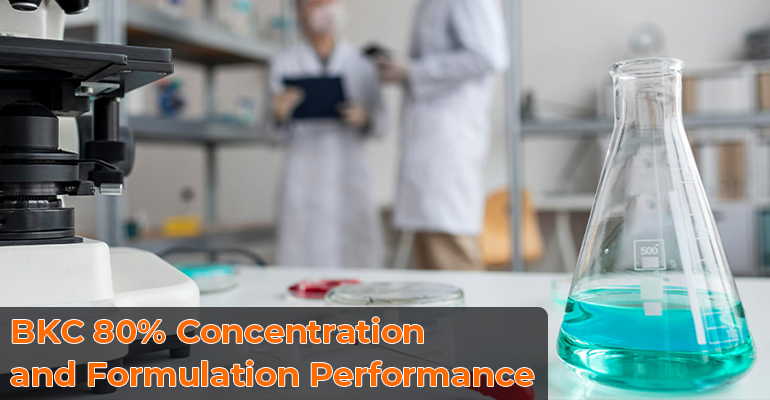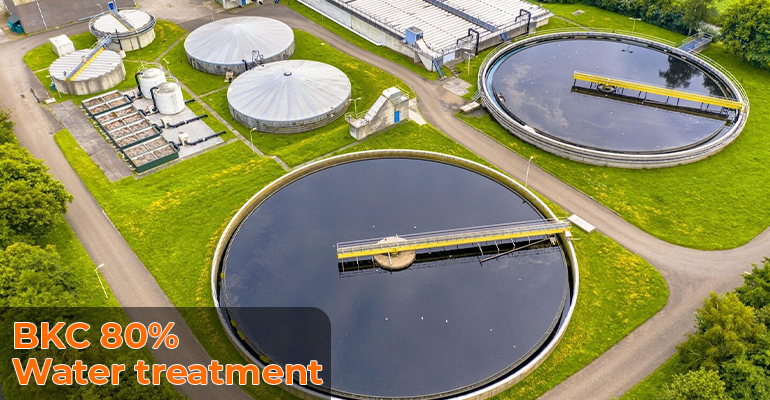

Benzalkonium Chloride Solution (BKC 80%) is a highly concentrated solution of Benzalkonium Chloride, which is a common ingredient for those products that need antibacterial effects and cationic surfactants. According to Maxwell Additives, their BKC 80% product is an Alkyl Dimethyl Benzyl Ammonium Chloride with predominance of C12–C14 chains and about 80% of active substance...
BKC 80 Chemical: Concentrated Quat Solution Guide
What is BKC 80 Chemical?
BKC 80 Chemical refers to a concentrated solution of Benzalkonium Chloride, a quaternary ammonium compound commonly known as a Quat. It is a cationic chemical that combines surface-active properties with antimicrobial functionality, making it useful in formulations where cleanliness, microbial control, and surface interaction are important. The “80” generally indicates the high active concentration of Benzalkonium Chloride in the supplied solution.
Unlike a simple cleaning ingredient, BKC 80 can perform several formulation roles depending on how it is incorporated into a finished product. It can contribute to wetting, surface contact, preservation, and microbial-control systems. Because of its concentrated nature, manufacturers can formulate products according to their required final concentration instead of depending on a lower-strength raw material.
The term Quat solution is often used because Benzalkonium Chloride belongs to the quaternary ammonium family. This class of chemicals is widely used in industrial and commercial formulations where cationic surface activity is required. BKC 80 is supplied as a liquid and is soluble in water, which makes handling and formulation convenient for many water-based systems.
For manufacturers, choosing the correct concentration is important. The required quantity of BKC 80 depends on the application, formulation design, regulatory requirements, and desired final active level. It should therefore be handled and incorporated according to the supplier’s technical information and the requirements of the finished product.
BKC 80 Chemical as a Flexible Formulation Ingredient
BKC 80 Chemical can be viewed as a formulation-support ingredient rather than simply a disinfecting chemical. Its concentrated form gives formulators room to design different products around a controlled active level. This flexibility can be particularly useful when a production facility makes several products that require different concentrations of the same active ingredient.
Another interesting aspect is its combination of chemical activity and surface interaction. A formulation may require an ingredient that does more than remain dissolved in water. BKC can interact with surfaces and other formulation components because of its cationic nature, making compatibility assessment an important part of product development.
The practical value of BKC 80 therefore depends on the complete formulation. Water quality, other surfactants, pH, concentration, contact conditions, and intended application can all influence the final performance. This means that purchasing a concentrated BKC 80 Chemical should be accompanied by proper formulation testing rather than relying only on a generic dosage.
For industrial buyers, consistency between batches is equally important. A dependable raw-material supply helps manufacturers maintain repeatable formulation characteristics, reduce unexpected adjustments, and keep production more predictable.
Features of BKC 80 Chemical
1. High-Concentration Liquid Form
BKC 80 is supplied as a concentrated liquid, allowing manufacturers to work with a stronger raw material during formulation. This can provide flexibility when preparing products that require different active levels. The liquid format also supports convenient integration into suitable manufacturing processes when handled according to recommended procedures.
2. Quaternary Ammonium Chemistry
BKC 80 belongs to the quaternary ammonium compound family, commonly described as a Quat. Its cationic character gives it distinctive interaction with surfaces and formulation ingredients. This chemical nature is one reason it is selected for applications requiring antimicrobial, surface-active, or preservation-related functionality.
3. Water Compatibility
A useful characteristic of BKC 80 is its ability to dissolve in water in all proportions according to the manufacturer’s stated specifications. This makes it suitable for many aqueous formulation systems. Actual compatibility should still be evaluated because other ingredients can influence stability, appearance, and final formulation performance.
4. Broad Industrial Utility
BKC 80 can be incorporated into different industrial formulations where microbial growth control, surface treatment, or cationic surfactant performance is required. Its use extends beyond one particular industry, giving manufacturers opportunities to develop specialized products around the same chemical raw material.
5. C12-C14 Alkyl Distribution
Commercial BKC 80 grades commonly contain predominantly C12-C14 alkyl chains. This composition contributes to the characteristic behavior of the material as a quaternary ammonium compound. Understanding the alkyl distribution can help formulators select a grade that is appropriate for their intended product and processing requirements.
6. Convenient Industrial Handling
Because BKC 80 is supplied in liquid form, it can be incorporated into suitable production systems without first converting a solid raw material into a usable solution. Proper storage remains essential, including protection from direct sunlight and following the supplier’s recommended handling and packaging instructions.
7. Formulation Versatility
BKC 80 can work alongside selected non-ionic, amphoteric, and cationic surface-active materials, although compatibility should always be confirmed through formulation trials. This characteristic gives product developers greater freedom when designing cleaning, maintenance, textile, coating, and other industrial formulations.
BKC 80 Chemical for Efficient Industrial Formulation
The usefulness of BKC 80 Chemical becomes clearer when viewed from the perspective of formulation efficiency. A concentrated chemical allows manufacturers to determine the active level required for a particular product instead of treating every application as though it needs the same concentration.
This is especially relevant for companies producing multiple formulations. One raw material can potentially support different product designs when the formulation team understands concentration, compatibility, water quality, and application requirements. It can simplify raw-material planning while giving greater control over the final composition.
BKC 80 can also have value in systems where both surface interaction and microbial management are considered. For example, industrial products may require an ingredient that supports the overall functional behavior of a formulation while contributing antimicrobial properties. In such cases, the chemical needs to be evaluated as part of the entire formulation rather than as an isolated ingredient.
Another consideration is quality consistency. A chemical formulation can be affected by variations in active content, appearance, impurities, or physical characteristics. Working with a consistent BKC 80 Manufacturer & Supplier can help reduce raw-material variation and support more stable production results.
For buyers in India, supplier selection should therefore include more than price comparison. Technical specifications, active concentration, packaging, batch consistency, documentation, storage guidance, and supply capability can all influence the real value of a chemical purchase.
 Benefits of BKC 80 Chemical
1. Supports Microbial Control
BKC 80 can contribute to formulations designed for controlling unwanted microbial growth. This makes it relevant to industrial products where bacterial or fungal contamination can affect quality, storage life, or process conditions. Its actual effectiveness depends on concentration, formulation, contact conditions, target organisms, and applicable regulatory requirements.
2. Useful for Concentrated Formulations
The high active concentration gives manufacturers greater flexibility when designing finished products. Instead of starting with a very dilute raw material, formulators can calculate the required quantity based on the desired final concentration. This can make formulation planning more adaptable across different product categories.
3. Helps Develop Versatile Products
BKC 80 can be incorporated into several types of industrial formulations, allowing one chemical raw material to serve different development needs. Its use in cleaning, textile, coating, water-related, and preservation systems demonstrates the breadth of applications possible when compatibility and dosage are properly evaluated.
4. Provides Surface-Active Functionality
As a cationic surfactant, BKC 80 offers surface-active behavior in addition to its antimicrobial role. This can be valuable in formulations where interaction with surfaces is part of the desired performance. Proper compatibility testing is necessary before combining it with other surfactants or formulation ingredients.
5. Suitable for Water-Based Systems
Its water compatibility makes BKC 80 convenient for many aqueous products. Manufacturers can incorporate the material into suitable water-based formulations while controlling the final concentration according to their requirements. This can simplify product development when water is the primary formulation medium.
6. Supports Process Protection
In suitable industrial systems, BKC 80 can help address microbial contamination that may otherwise interfere with processing or product quality. This can be particularly relevant to materials such as coatings, adhesives, slurries, and process waters where biological growth can create operational difficulties.
7. Flexible Raw-Material Choice
A concentrated Quat solution gives manufacturers another option when selecting antimicrobial and surface-active raw materials. BKC 80 can be evaluated against application requirements, cost targets, compatibility needs, and desired active concentration, helping formulation teams make a more informed chemical selection.
Conclusion
BKC 80 Chemical is a concentrated Benzalkonium Chloride solution belonging to the quaternary ammonium or Quat family. Its combination of cationic surface activity and antimicrobial functionality makes it relevant to a wide range of industrial formulations. Its concentrated nature also provides flexibility for manufacturers developing products with different active levels.
From cleaning and textile formulations to coatings, process systems, water-related applications, and microbial-control products, BKC 80 can serve different technical purposes. However, its performance should always be considered in relation to the complete formulation, intended use, concentration, and compatibility requirements.
For businesses sourcing a BKC 80 Manufacturer & Supplier, technical consistency, documentation, packaging, storage guidance, and dependable supply should be considered alongside price. A well-selected raw material can help manufacturers maintain more predictable formulation and production outcomes.
FAQs
1. What is BKC 80 Chemical used for?
BKC 80 Chemical is a concentrated Benzalkonium Chloride solution used in suitable industrial and commercial formulations for antimicrobial control, surface-active functions, preservation-related applications, cleaning products, textile treatments, coatings, and other process systems. The exact application and concentration should be determined according to the finished product and applicable requirements.
2. Why is BKC 80 called a Quat solution?
BKC 80 is called a Quat solution because Benzalkonium Chloride belongs to the quaternary ammonium compound family. “Quat” is a commonly used industry term for these cationic compounds. BKC 80 is supplied as a concentrated liquid solution containing Benzalkonium Chloride.
3. Is BKC 80 suitable for water-based formulations?
Yes, BKC 80 can be used in suitable water-based formulations because the manufacturer’s specifications state that it is soluble in water in all proportions. However, formulators should test compatibility with other ingredients before commercial production because the overall formulation can affect stability and performance.
4. How should BKC 80 be stored?
BKC 80 should be stored according to the supplier’s technical and safety recommendations. Maxwell Additives’ published product information advises keeping the material under shade and protecting it from direct sunlight. Appropriate packaging, handling, and storage conditions should be maintained throughout the supply chain.
5. Can BKC 80 be mixed with other surfactants?
BKC 80 may be compatible with selected non-ionic, amphoteric, and cationic surface-active agents, but compatibility should not be assumed for every formulation. Manufacturers should conduct laboratory trials before combining it with other raw materials to confirm stability, appearance, activity, and the desired final product characteristics.
6. What should buyers check before purchasing BKC 80?
Buyers should review active concentration, chemical specifications, appearance, packaging, batch consistency, technical documentation, storage requirements, and supply reliability. It is also useful to discuss the intended application with the supplier so the appropriate grade and handling requirements can be evaluated before placing a bulk order.
7. Can Maxwell Additives supply BKC 80 Chemical?
Yes. Maxwell Additives PVT LTD lists BKC 80% Benzalkonium Chloride among its specialty chemical products and provides specifications covering active content, appearance, density, pH, alkyl distribution, solubility, and packaging. Buyers should contact the company directly for current commercial availability, technical documentation, and order-related information.
Related Posts