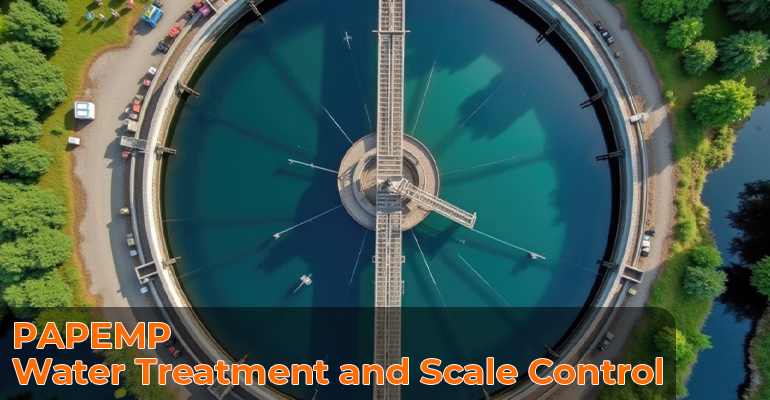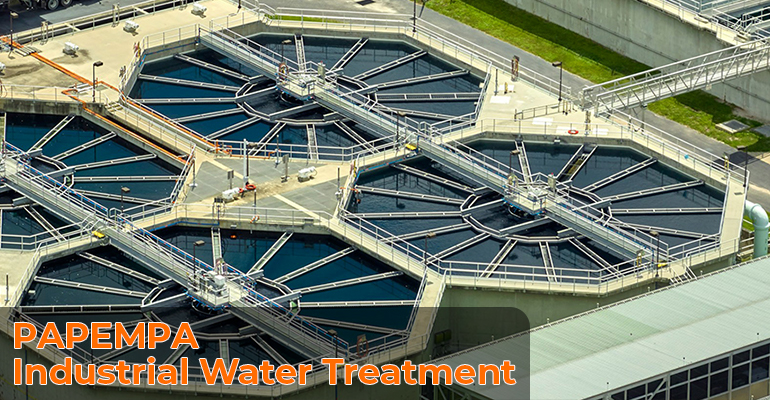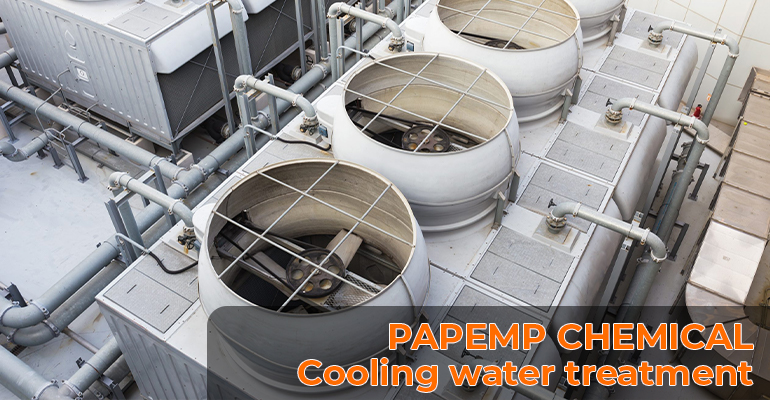
PAPEMP phosphonate chemicals are one such group of specialty treatment chemicals. PAPEMP stands for Polyamino Polyether Methylene Phosphonic Acid and is used in industrial formulations where metal-ion control, mineral management, dispersion, and formulation stability are important...
Corin-Polymer EXACTA-1000-P: Phosphorus Carboxylate Polymer for Water Treatment
What is PAPEMP?
Polyamino Polyether Methylene Phosphonic Acid (PAPEMP) is a specialty organophosphonic compound used in industrial formulations where mineral control, metal-ion management, and water-system stability are important. It belongs to a group of phosphonic materials designed to interact with dissolved metal ions and influence the formation and behavior of unwanted deposits.
The chemical is also commonly identified as Polyamino Polyether Methylene Phosphonic Acid, Polyamino Polyether Methylene Phosphonic, or Polyamino Polyether Methylene Phosphonic Acid – PAPEMP. Its molecular structure contains functional groups that provide useful interactions with minerals and metal ions in aqueous environments. Maxwell Additives lists PAPEMP under its PHOSPHOMAN-230 product range.
In practical industrial use, PAPEMP can be considered when conventional treatment chemicals are not sufficient for complicated water conditions. Systems containing different dissolved minerals may experience deposits that gradually affect equipment surfaces and process efficiency. A properly selected PAPEMP formulation can help manage these challenges as part of a complete treatment program.
Its value comes from the combination of several chemical functions rather than from a single property. PAPEMP can participate in sequestration, dispersion, and threshold inhibition, allowing formulators to address mineral-related problems from different angles. This makes it relevant to industrial water-treatment and process formulations where changing water chemistry needs to be managed carefully.
The exact performance of PAPEMP depends on factors such as mineral concentration, pH, temperature, dosage, water composition, and the other chemicals present in the formulation. Therefore, it is better to select and dose the material according to actual operating conditions instead of treating it as a universal solution.
Features of PAPEMP
1. Strong Metal-Ion Interaction
PAPEMP contains multiple functional groups capable of interacting with dissolved metal ions in aqueous systems. This characteristic can help manage calcium, magnesium, iron, copper, and other ions that influence mineral deposition. Such interaction is useful when water-treatment formulations need better control over changing mineral conditions during industrial operation.
2. Effective Mineral Deposition Control
PAPEMP can interfere with the development of several mineral deposits that commonly create operational problems. Its activity can influence crystal growth and precipitation behavior, helping treatment systems manage calcium carbonate, calcium sulphate, calcium phosphate, and silica-related scale under appropriate operating conditions and carefully selected treatment concentrations.
3. Good Water Compatibility
PAPEMP is supplied as a water-compatible liquid product, making it convenient for aqueous industrial formulations. Maxwell’s published product information states that its PAPEMP grade is soluble in water in all proportions. This characteristic can simplify incorporation into treatment solutions and support uniform distribution throughout circulating water systems.
4. Dispersion Support
PAPEMP offers dispersing properties that can be useful when small mineral particles are present in process water. Rather than allowing suspended material to easily gather into larger deposits, an appropriate formulation can help maintain better particle distribution. This property gives PAPEMP value in systems where both precipitation and particle accumulation need attention.
5. Performance Under Challenging Conditions
Industrial water systems may experience high mineral content, changing temperatures, alkaline conditions, or elevated pH. PAPEMP is designed for demanding treatment environments and can remain useful under such conditions when correctly formulated. Its stability and functional versatility make it suitable for applications where treatment chemistry must remain dependable during process changes.
6. Threshold Inhibition Capability
PAPEMP can work through threshold inhibition, where relatively small quantities of an inhibitor influence the formation of larger amounts of mineral scale. Its effectiveness depends on mineral type, water composition, supersaturation, temperature, pH, and dosage. Proper process testing is therefore important before determining the final treatment concentration.
7. Multifunctional Phosphonic Chemistry
The combination of metal-ion interaction, dispersion, and scale-control properties gives PAPEMP a multifunctional role in industrial formulations. Instead of focusing on only one water-quality issue, formulators can evaluate it as part of a broader treatment strategy. This makes Polyamino Polyether Methylene Phosphonic Acid relevant to several demanding process environments.
A Multifunctional Approach to Industrial Water Chemistry
PAPEMP is best understood not simply as another phosphonate, but as a chemical option for situations where several water-quality factors occur together. Industrial systems can contain hardness ions, suspended particles, dissolved metals, and silica at the same time. Managing one issue while ignoring another may leave the overall problem unresolved.
This is where the multifunctional character of Polyamino Polyether Methylene Phosphonic Acid becomes important. Its interaction with metal ions can influence the availability of minerals, while its dispersing behavior can help manage particles that might otherwise contribute to deposit formation. The result is a broader approach to water chemistry management.
A practical example can be seen in circulating industrial water. As water repeatedly moves through equipment, its composition can change because of evaporation, make-up water, temperature fluctuations, and concentration cycles. These changes can increase the possibility of mineral precipitation. PAPEMP can be evaluated within the treatment program to help keep such changes under control.
Polyamino Polyether Methylene Phosphonic Acid (PAPEMP) may also be useful when the water contains more than one scale-forming component. Calcium carbonate is a familiar concern, but calcium sulphate, calcium phosphate, silica, and other deposits may also appear depending on the process. A chemical with broader activity can provide formulators with greater flexibility when designing a treatment program.
However, chemical selection should never be based only on the name of the product. A good formulation considers the actual water analysis, operating temperature, pH, mineral concentration, equipment material, residence time, and other additives. These details determine whether PAPEMP will provide the expected result.
For procurement teams, consistency is equally important. A PAPEMP product should be evaluated through its technical specifications, active content, physical appearance, storage requirements, and batch-to-batch consistency. Maxwell’s published specification for PHOSPHOMAN-230 describes a liquid product with a pale-yellow to off-white appearance, minimum 40% active content as acid, and water solubility in all proportions.
Another consideration is compatibility with the rest of the treatment formulation. PAPEMP may be combined with other water-treatment ingredients, but the final mixture should be tested for stability and performance. A laboratory trial can reveal whether the selected concentration and combination are suitable before introducing the formulation into a full-scale industrial system.
This practical approach makes PAPEMP more than a scale inhibitor. It becomes one component of a carefully designed water-management strategy aimed at maintaining stable operating conditions and reducing the impact of mineral-related problems.
Benefits of PAPEMP
1. Helps Manage Scale Formation
PAPEMP can help reduce the tendency of certain dissolved minerals to develop into troublesome deposits. By influencing precipitation and crystal growth, it supports a cleaner operating environment within suitable water-treatment systems. This can be particularly valuable where recurring mineral buildup creates maintenance or efficiency concerns.
2. Supports Better Water-System Stability
Changes in water chemistry can make industrial systems difficult to control. PAPEMP provides metal-ion interaction and dispersion properties that can support more stable treatment conditions. When appropriately dosed, it can help maintain mineral control as water moves through heating, cooling, circulation, or concentration cycles.
3. Useful for Complex Mineral Conditions
Some industrial water contains several scale-forming substances rather than one isolated contaminant. PAPEMP can address multiple mineral-control requirements, including calcium-based and silica-related deposition. This broader activity gives formulators an option when treatment programs need to manage different types of mineral behavior simultaneously.
4. Can Support Equipment Protection
Mineral deposits can interfere with heat-transfer surfaces, pipelines, valves, and other equipment components. By helping control deposit formation, PAPEMP can support a cleaner system and reduce the operational impact associated with accumulated scale. It works best as part of a complete program designed around the specific equipment and water chemistry.
5. Offers Formulation Flexibility
The multifunctional nature of PAPEMP gives formulators flexibility when developing industrial treatment products. Its metal-ion interaction, dispersion, and scale-inhibition properties can be considered together rather than treating each requirement separately. This can be useful when developing solutions for demanding water conditions with several simultaneous challenges.
6. Performs in Demanding Water Conditions
PAPEMP is intended for applications where water chemistry can be difficult to manage. Its useful properties under high mineral loading and variable process conditions make it suitable for carefully designed industrial treatment programs. Actual performance should still be confirmed through laboratory evaluation and controlled field testing.
7. Helps Improve Treatment Efficiency
By combining several useful functions in one phosphonic compound, PAPEMP can contribute to a more balanced treatment approach. Effective mineral control can reduce the need to repeatedly address deposit-related problems. The overall result depends on correct dosage, compatible additives, suitable operating conditions, and regular monitoring of the treatment system.
Conclusion
Polyamino Polyether Methylene Phosphonic Acid (PAPEMP) is a multifunctional phosphonic compound that can play an important role in industrial water and process treatment. Its ability to interact with metal ions, influence mineral precipitation, and support dispersion makes it useful for challenging water conditions.
Rather than treating PAPEMP as a universal chemical, industries should evaluate it according to their actual water chemistry and process requirements. Proper testing, dosage selection, compatibility checks, and ongoing monitoring can help achieve dependable results.
The flexibility of Polyamino Polyether Methylene Phosphonic Acid makes it a valuable option for formulators looking for broader mineral-control performance in industrial systems.
FAQs
1. What is PAPEMP used for?
PAPEMP is mainly considered for industrial water and process-treatment applications where scale formation, mineral deposition, metal-ion management, and particle dispersion are concerns. It can be evaluated for cooling-water systems, oilfield water, paper and pulp processes, industrial cleaning, and other aqueous applications depending on the formulation requirements.
2. Is PAPEMP the same as Polyamino Polyether Methylene Phosphonic Acid?
Yes. PAPEMP is the commonly used abbreviation for Polyamino Polyether Methylene Phosphonic Acid. The chemical may also appear in commercial documents as PAPEMPA or Polyamino Polyether Methylene Phosphonic. Buyers should still compare the technical specification of the particular grade they are purchasing.
3. Which scales can PAPEMP help control?
PAPEMP can provide inhibition against several mineral deposits, including calcium carbonate, calcium sulphate, calcium phosphate, and silica-related scale. Its actual performance depends on water composition, temperature, pH, supersaturation, mineral concentration, and dosage, so application testing is recommended before finalizing a treatment program.
4. Can PAPEMP be used in high-hardness water?
PAPEMP can be considered for water systems with significant mineral loading because of its metal-ion interaction and scale-control properties. However, high hardness alone does not determine the required dosage. Calcium concentration, alkalinity, temperature, pH, other ions, and concentration cycles should also be evaluated.
5. Is PAPEMP soluble in water?
Yes. Maxwell Additives’ published information for its PHOSPHOMAN-230 PAPEMP grade states that the product is soluble in water in all proportions. The actual handling and mixing procedure should follow the supplier’s current technical and safety documentation.
6. How is the correct PAPEMP dosage decided?
There is no single dosage suitable for every industrial system. The required amount depends on water chemistry, mineral concentration, temperature, pH, operating conditions, and the other chemicals used in the treatment program. Laboratory testing and controlled plant trials are recommended before setting a final dosage.
7. Can PAPEMP be used with other treatment chemicals?
PAPEMP can be evaluated as part of a broader treatment formulation, but compatibility should be checked before combining it with other chemicals. Formulators should conduct stability and performance testing to ensure that the combination does not produce unwanted precipitation, interactions, or changes in treatment efficiency.
Related Posts