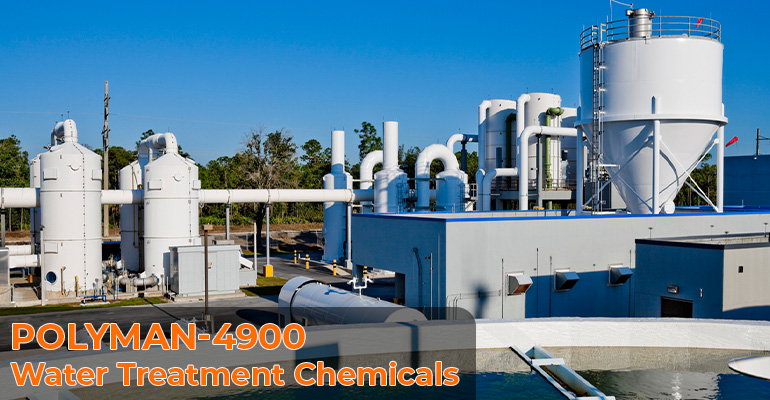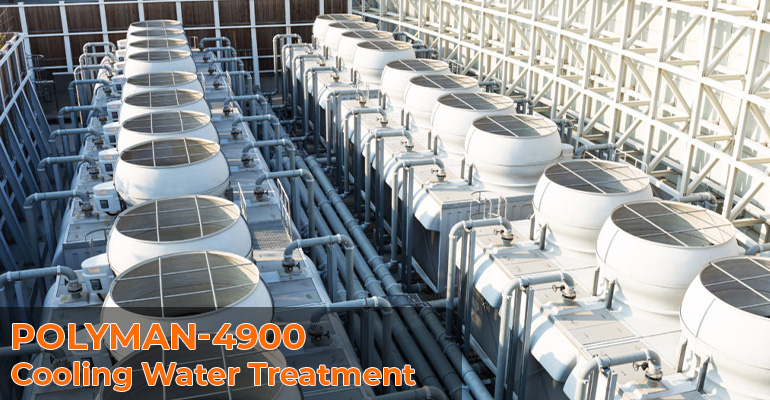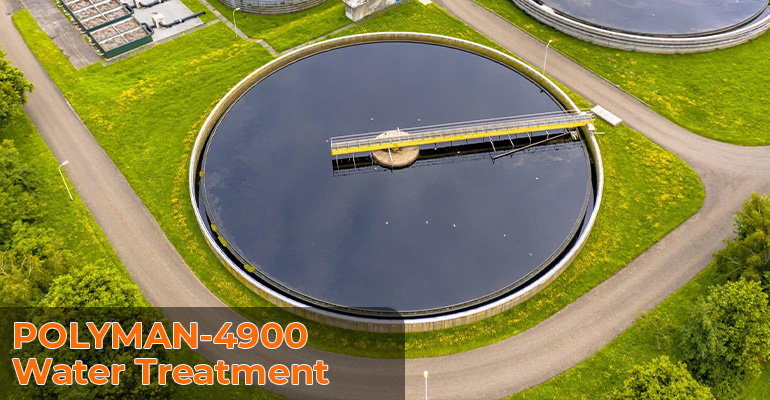
Industrial water treatment formulations are designed to deal with a range of issues such, as minerals, hardness ions and suspended particles. These problems can affect how equipment performs and how smoothly the entire process operates. If left unchecked these problems can lead to deposits of minerals or hardness materials. Such buildup often happens on heat‑transfer surfaces, pipes and other components and such buildup can reduce efficiency and cause problems...
POLYMAN-4900 for Efficient Industrial Water Treatment
 POLYMAN-4900 is a polymer designed for industrial water-treatment applications. It belongs to the family of specialty polymers used where dispersion and control of mineral deposits are important. The product is listed by Maxwell Additives as a carboxylic-sulfonate ter-polymer, with a liquid form, approximately 50% solid content, and water solubility in all proportions.
The following content explains the material from a practical industrial perspective, with fresh wording and a different structure rather than reproducing the existing product-page language.
What is POLYMAN-4900 Carboxylic Sulfonate Multi Polymer?
POLYMAN-4900 Carboxylic Sulfonate Multi Polymer is a specialty polymer used in water-based industrial formulations, particularly where mineral dispersion and deposit management are required. Its polymer structure contains different functional groups that help it interact with mineral particles in water. This makes it useful when untreated mineral matter could gradually affect equipment surfaces or process efficiency.
The product is classified by Maxwell Additives as a CARBOXYLIC-SULFONATE TER-POLYMER. It is a low-molecular-weight liquid polymer with an average molecular weight of approximately 2,000. The manufacturer reports a pH of around 3.0, density of approximately 1.30, and solid content of about 50%. It is also described as soluble in water in all proportions.
In simple terms, POLYMAN-4900 helps manage the way mineral particles behave inside water systems. Instead of allowing hardness-related materials to easily collect and contribute to deposits, a suitable treatment program can use the polymer to improve dispersion and support scale-control performance.
This type of chemistry can be considered for cooling-water treatment, industrial water circuits, and other water-based formulations. However, actual performance depends on water chemistry, operating temperature, hardness, dosage, and the presence of other treatment chemicals.
How POLYMAN-4900 Helps Control Mineral Deposits
One useful way to understand POLYMAN-4900 is to look at the problem it addresses rather than focusing only on its chemical classification. Industrial water can contain calcium, magnesium, iron oxide particles, and other dissolved or suspended materials. When process conditions change, these materials may become difficult to control.
A polymeric treatment chemical can help change this behavior. The aim is not simply to remove every mineral from the water. Instead, the treatment strategy can focus on keeping unwanted particles dispersed and reducing their tendency to participate in deposit formation.
The sulfonate component is also important to the overall behavior of this type of polymer. Sulfonated groups can provide strong ionic characteristics, which may influence interactions with suspended particles. Combined with carboxylic functionality, the polymer can provide a broader approach to managing mineral matter than a single-function material.
This is why the term Carboxylic Sulfonate Multi Polymer is useful when discussing its application. The material is not intended to perform only one narrow task; its polymer structure can support several aspects of water-system control when used under appropriate conditions.
For industries, the practical question is therefore not simply whether a polymer works, but whether it remains suitable under the specific combination of hardness, temperature, pH, contaminants, and treatment chemistry present in the plant.
Features
1. Low-Molecular-Weight Polymer
POLYMAN-4900 has an average molecular weight of approximately 2,000, placing it in the low-molecular-weight polymer category. This characteristic is relevant when a formulation requires a material capable of interacting with mineral particles while maintaining useful dispersing behavior. The molecular structure can contribute to practical performance in water-treatment applications.
2. Carboxylic-Sulfonate Chemistry
The combination of carboxylic and sulfonate functionality gives POLYMAN-4900 its distinctive chemical character. These groups can influence how the polymer interacts with suspended particles and dissolved minerals. Such functionality is valuable when a water-treatment formulation needs more than simple mineral binding and requires broader control over particle behavior.
3. Liquid Form
POLYMAN-4900 is supplied as a liquid, which can be convenient for industrial dosing and formulation. Liquid materials can be measured and introduced into treatment systems using suitable dosing equipment. This can make integration easier for facilities that already operate liquid chemical feed systems for continuous or batch water treatment.
4. High Water Solubility
The product is reported to be soluble in water in all proportions. This characteristic can simplify preparation and incorporation into water-based systems. Good water solubility is particularly useful when the polymer needs to be distributed throughout a treatment stream rather than remaining as undissolved material during normal formulation or dosing.
5. Non-Phosphorus Composition
POLYMAN-4900 is described as a non-phosphorus polymer. This can be relevant for industries evaluating treatment programs where phosphorus-containing additives are being reduced or avoided. The choice of a non-phosphorus polymer can provide another route for developing water-treatment formulations while still addressing dispersion and mineral-deposit management requirements.
6. Non-Foaming Character
The material is identified as a non-foaming dispersant. This can be beneficial in industrial systems where excessive foam could interfere with circulation, measurement, equipment operation, or process visibility. A low-foaming treatment component can make chemical management easier when the complete formulation and operating conditions are properly controlled.
7. Suitable for Water-Based Formulations
POLYMAN-4900 is intended for industrial water-treatment applications and can also be used in water-based formulations. Its liquid form and water compatibility make it practical for systems where the chemical needs to be distributed through an aqueous phase. This provides flexibility across different treatment setups and industrial processing environments.
Factors Affecting POLYMAN-4900 Performance
The performance of a water-treatment polymer should always be judged as part of a complete treatment program. A polymer may show excellent results in one water system but require a different dosage or supporting chemistry in another. Factors such as calcium concentration, magnesium level, iron content, alkalinity, temperature, pH, and residence time can all influence results.
For this reason, POLYMAN-4900 should not be viewed as a universal replacement for every other water-treatment chemical. Instead, it can be selected as a functional component within a treatment strategy.
For example, a cooling-water system may experience repeated concentration of dissolved minerals because water is continuously circulated and evaporation removes part of the water. Without suitable control, the concentration of hardness-forming ions can increase. A polymeric dispersant and scale-control chemical can help manage the resulting mineral behavior.
The same principle applies to industrial process-water systems. If suspended particles are allowed to aggregate, they may become more difficult to control. Keeping particles better dispersed can support cleaner operation and reduce the likelihood of deposit-related problems.
The most suitable dosage should therefore be established through technical evaluation rather than simply following a fixed number for every application. Laboratory testing, plant trials, and monitoring of water chemistry can help determine how POLYMAN-4900 should be incorporated into the treatment program.
 Benefits
1. Supports Scale Management
POLYMAN-4900 can support scale-management programs by influencing mineral behavior in treated water. This is useful in systems where hardness-related deposits can gradually develop on equipment surfaces. By improving control of mineral matter, the polymer can contribute to a treatment approach focused on maintaining cleaner operating conditions.
2. Helps Maintain Mineral Dispersion
When mineral particles gather together, they can become harder to manage. POLYMAN-4900 provides dispersing action that can help keep suitable particles distributed through the water phase. Better dispersion may reduce the tendency of suspended matter to collect in unwanted locations during normal industrial operation.
3. Useful for Cooling-Water Systems
Cooling systems often face challenges caused by repeated water circulation, evaporation, hardness concentration, and changing operating temperatures. POLYMAN-4900 can be considered as part of a suitable cooling-water treatment program where scale and dispersion control are required to support reliable system performance.
4. Works in Water-Based Formulations
The water-soluble nature of POLYMAN-4900 makes it convenient for applications based on aqueous formulations. It can be incorporated into suitable water-treatment mixtures and other industrial liquid systems. This provides formulators with a polymer option that can be distributed through the water phase without requiring special insoluble-particle handling.
5. Provides Non-Phosphorus Treatment Chemistry
For industries seeking to reduce phosphorus-containing components, a non-phosphorus polymer can be useful during formulation development. POLYMAN-4900 offers such an option while providing dispersant and scale-control functionality. The environmental suitability of the overall treatment program should still be assessed based on the complete chemical composition and discharge requirements.
6. Can Perform Under Varied Water Conditions
Industrial water rarely remains identical throughout the year. Hardness, temperature, concentration cycles, and other parameters can change with production conditions. POLYMAN-4900 can be evaluated for systems with changing conditions because its polymer chemistry is designed to provide useful mineral-control performance across suitable industrial operating environments.
7. Helps Improve Treatment Flexibility
A versatile polymer can give water-treatment formulators another tool when designing chemical programs. POLYMAN-4900 can be evaluated alongside other compatible treatment ingredients to address specific process requirements. This flexibility allows the treatment strategy to be adjusted according to the actual water chemistry rather than relying on one chemical for every problem.
Where Can POLYMAN-4900 Be Considered?
POLYMAN-4900 is primarily associated with industrial water treatment and cooling-water applications. These systems can experience mineral concentration and deposit-related problems because water is repeatedly circulated through equipment.
It can also be considered for other water-based formulations where dispersing and scale-control characteristics are required. The suitability of the polymer will depend on the formulation’s ingredients and operating conditions.
For industrial users, application testing is an important step. A controlled trial can reveal how the polymer interacts with existing treatment chemicals and whether the selected dosage provides the desired result.
Conclusion
POLYMAN-4900 Carboxylic Sulfonate Multi Polymer is a specialty polymer designed for industrial water-treatment applications where mineral dispersion and scale management are important. Its carboxylic-sulfonate structure, low molecular weight, liquid form, water solubility, and non-phosphorus character make it a useful option for evaluating different water-treatment requirements.
The material can be considered particularly where cooling-water and industrial water systems face challenges related to hardness, suspended particles, and mineral deposits. However, the right dosage and treatment combination should always be established according to actual water chemistry and process conditions.
A well-designed treatment program does more than add chemicals. It considers the source of the deposit problem, the water composition, equipment conditions, operating temperature, and the interaction between different treatment ingredients. POLYMAN-4900 can be one component of that broader approach.
FAQs
1. What is POLYMAN-4900 used for?
POLYMAN-4900 is used mainly in industrial water-treatment applications where dispersant and scale-control performance is required. It can be considered for cooling-water systems and other water-based formulations. The final application should be selected according to the site’s water chemistry and operating conditions.
2. Is POLYMAN-4900 a Carboxylic Sulfonate Multi Polymer?
POLYMAN-4900 is described by Maxwell Additives as a carboxylic-sulphonate ter-polymer. It is also associated with terms such as Carboxylic Sulfonate Multi Polymer in product categorization. Buyers should always refer to the latest technical documentation when confirming the exact polymer classification.
3. Can POLYMAN-4900 control calcium-related deposits?
POLYMAN-4900 is designed to provide calcium-trapping and scale-control characteristics. Its performance can help manage mineral behavior in suitable water systems. However, calcium concentration, alkalinity, temperature, pH, and other treatment chemicals can influence the final result, so application-specific testing is recommended.
4. Is POLYMAN-4900 suitable for cooling-water treatment?
Yes, the product is specifically associated with industrial and cooling-water treatment. It can be incorporated into a suitable treatment program where mineral dispersion and scale control are needed. The correct dosage should be determined after considering the cooling system’s water quality and operating conditions.
5. Is POLYMAN-4900 soluble in water?
Yes. The manufacturer’s published information states that POLYMAN-4900 is soluble in water in all proportions. This makes it convenient for aqueous treatment systems where the chemical needs to be distributed through the water phase during dosing or formulation.
6. Is POLYMAN-4900 a phosphorus-based polymer?
No. POLYMAN-4900 is described as a non-phosphorus polymer. This can make it relevant for treatment programs where manufacturers want to use polymeric scale and dispersion chemistry without adding phosphorus through this particular component. Overall environmental requirements should be checked for the complete treatment program.
7. Why should I consider Maxwell Additives for POLYMAN-4900?
Maxwell Additives lists POLYMAN-4900 within its specialty polymer range and provides technical information covering its properties, applications, storage, handling, and packaging. The company identifies the material as a carboxylic-sulphonate ter-polymer intended for industrial water-treatment applications. Buyers should discuss their actual process conditions with the supplier before finalizing the grade and dosage.
Related Posts