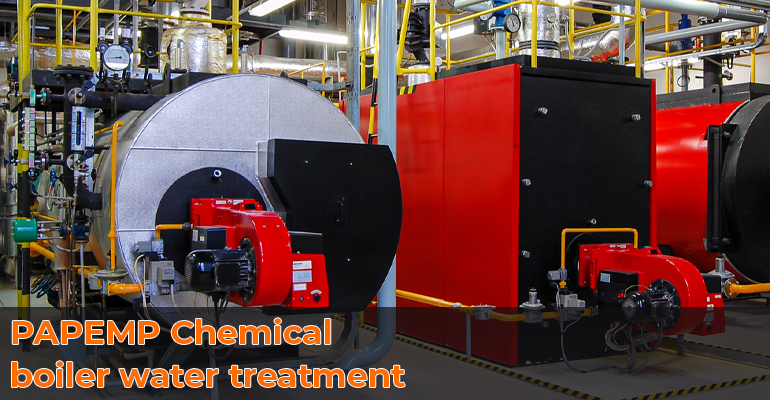
Polyamino polyether methylene phosphonic acid (PAPEMP Acid) is a phosphonate-based chemical that can contribute to this type of formulation management. Its molecular structure provides multiple functional sites that can interact with metal ions while also supporting dispersion and mineral-control functions. PAPEMP is also known as PAPEMPA in industrial chemical terminology. Maxwell Additives identifies its PHOSPHOMAN-230 product as PAPEMP/PAPEMPA and describes properties including sequestration, deflocculation, threshold inhibition, hydrolytic stability, and compatibility with demanding aqueous conditions...
PAPEMP : Polyamino Polyether Methylene Phosphonic Acid for Scale, Sequestration Water Treatment Applications
PAPEMP, also known as Polyamino Polyether Methylene Phosphonic Acid, is a specialty organophosphonic acid used in industrial water-treatment and other demanding chemical formulations. Its combination of scale inhibition, sequestration, dispersion, threshold inhibition, corrosion-control support, and hydrolytic stability makes it useful in applications where conventional treatment chemistry may need additional performance under challenging operating conditions. For companies sourcing PAPEMP regularly, choosing a reliable Polyamino Polyether Methylene Phosphonic Acid manufacturer and supplier is important for maintaining consistent product quality, dependable availability, and smoother production planning.
For companies sourcing PAPEMP regularly, choosing a reliable PAPEMP manufacturer and supplier in India is also important for maintaining consistent product quality, dependable availability, and smoother production planning.
What is PAPEMP ?
PAPEMP stands for Polyamino Polyether Methylene Phosphonic Acid. It is an organophosphonic acid containing functional groups that can interact with mineral-forming species and metal ions in aqueous systems.
PAPEMP is particularly relevant when a treatment program needs to address more than one challenge at the same time. Depending on the formulation and operating conditions, it can contribute to :
- Scale inhibition
- Threshold inhibition
- Metal-ion sequestration
- Crystal and particulate dispersion
- Corrosion-control programs
- Hydrolytic stability
- Stability under demanding water-treatment conditions
PAPEMP can interact with mineral-forming species involving calcium, magnesium, strontium, barium, and silicates. It can also help stabilize certain metal ions, including zinc, manganese, iron, and copper, depending on the application conditions.
PHOSPHOMAN – 230: PAPEMP from Maxwell Additives
PHOSPHOMAN- 230 is Maxwell Additives’ PAPEMP product. It is listed within the company’s phosphonate range alongside other specialty phosphonates used in industrial and water-treatment applications.
Chemical Specifications of PHOSPHOMAN – 230
| Property | PHOSPHOMAN-230 |
| Chemical Name | Polyamino Polyether Methylene Phosphonic Acid |
| Common Name | PAPEMP / PAPEMPA |
| CAS No. | 130668-24-5 |
| Molecular Weight | About 600 |
| Physical State | Liquid |
| Color | Pale yellow to off-white |
| pH, 1% Solution | < 2.0 |
| Active Content | 40% min. as acid |
| Phosphorous Acid | 1% max. |
| Density at 20°C | 1.15 min. |
| Solubility in Water | Soluble in all proportions |
The specifications above are based on Maxwell Additives’ published product information and should be confirmed against the current product specification and technical documentation before commercial use.
A Different Look at PAPEMP
Industrial water systems are rarely chemically static. Water may pass repeatedly through equipment, experience evaporation or concentration changes, encounter different mineral loads, or operate at elevated temperatures. These changes can increase the possibility of mineral precipitation, deposition, and metal-ion-related process problems.
Rather than functioning only as a conventional scale inhibitor, PAPEMP provides several properties that can work together within a formulation. Its phosphonic-acid functionality can interact with mineral-forming species and metal ions, while its dispersing characteristics can help limit the agglomeration of growing crystals and particulate material.
However, PAPEMP should not be viewed as a universal solution for every water chemistry. Actual performance depends on the composition of the water, operating conditions, concentration of scale-forming species, temperature, pH, and interaction with other chemicals.
Major Properties of PAPEMP
1. Scale Inhibition
Scale formation occurs when dissolved mineral species become supersaturated and begin forming crystals or deposits on process equipment and surfaces.
The material can be evaluated for controlling deposits associated with minerals such as:
- Calcium carbonate
- Calcium sulphate
- Calcium phosphate
- Silica and silicate-related deposits
- Magnesium-containing mineral deposits
- Strontium and barium salts
PAPEMP can interact with developing crystal surfaces and influence crystal growth, helping modify the conditions under which deposits form. Its effectiveness depends on water chemistry, supersaturation, temperature, pH, mineral concentration, and treatment conditions.
2. Threshold Inhibition
One of the important characteristics of phosphonate chemistry is the threshold effect.
PAPEMP can be adsorbed at active growth sites of developing mineral crystals. This can alter crystal-growth behavior and help reduce the tendency of certain dissolved minerals to develop into hard deposits.
3. Sequestration and Metal-Ion Management
Sequestration is the ability of a chemical to form a stable, water-soluble complex with metal ions.
Sequestration performance depends on factors including pH, competing ions, concentration, and the overall chemistry of the formulation. Therefore, actual application testing remains an important part of product evaluation.
4. Corrosion-Control Support
Corrosion control in industrial water systems generally involves a combination of treatment mechanisms rather than a single chemical.
The effectiveness of such combinations depends on the complete formulation and the operating conditions of the system. Compatibility and application testing should therefore be performed before commercial implementation.
5. Chlorine Stability
Chlorine and other oxidizing chemicals are used in many industrial water-treatment and cleaning applications.
The stability of a complete treatment formulation should be verified because the presence and concentration of oxidizing agents, pH, temperature, and other ingredients can affect chemical stability.
How PAPEMP Fits Into Industrial Water Treatment
Industrial water treatment frequently requires several functions at once. A system may need scale control, metal-ion stabilization, particulate dispersion, and corrosion management while operating under high temperature, high mineral concentration, or changing water chemistry.
1. Cooling Water Treatment
Cooling-water systems continuously circulate water through heat-transfer equipment. Evaporation can increase the concentration of dissolved minerals, creating conditions that encourage scale formation.
The appropriate treatment level depends on the cooling-water chemistry, cycles of concentration, temperature, pH, hardness, alkalinity, and other treatment chemicals already in use.
2. Reverse Osmosis and Desalination
Reverse osmosis systems can encounter scaling caused by the concentration of dissolved salts on the feed side of the membrane.
Membrane compatibility, feedwater chemistry, operating recovery, temperature, and the complete antiscalant formulation should be evaluated before use.
3. Paper and Pulp Processing
Metal ions and mineral deposits can influence several stages of paper and pulp processing.
Application-specific testing can help determine whether PAPEMP is compatible with the process chemistry and whether it provides the desired level of metal-ion control.
4. Oil-Field Applications
PAPEMP is also relevant to selected oil-field chemical applications, including topside treatment and squeeze-treatment programs.
The final treatment design should be established according to the produced-water chemistry, temperature, pressure, mineral composition, and other field-specific conditions.
Other Applications of PAPEMP
PHOSPHOMAN – 230 can be considered for a broad range of compatible industrial formulations and processes, including:
- Cooling-water treatment
- Boiler treatment
- Reverse osmosis desalination
- Industrial and institutional cleaning
- Paper and pulp bleaching
- Textile bleaching
- Textile scouring
- Oil-field applications
- Oil-recovery squeeze treatment
- Peroxide stabilization
- Kaolin slurry deflocculation
- Aluminum etching
- Swimming-pool chemical formulations
- Trace-metal carriers in fertilizers
- Ore flotation
- Acid cleaners
- Bottle-washing formulations
- Cement retarders
- Metal passivation
- Geothermal water treatment
- Car-cleaning formulations
- Deinking formulations
- Sugar refining
- Leather chemical formulations
The suitability of PAPEMP should always be assessed against the actual formulation and process requirements rather than assuming that every listed application will require the same product concentration or treatment method. Maxwell Additives lists these application areas for PHOSPHOMAN – 230/PAPEMP.
Benefits of Using PAPEMP in Industrial Formulations
1. Multiple Treatment Functions
PAPEMP offers several properties within one chemical, including scale inhibition, sequestration, dispersion, threshold inhibition, and hydrolytic stability. This can give formulators greater flexibility when developing treatment programs.
2. Metal-Ion Stabilization
Its ability to interact with selected metal ions can support formulations where calcium, magnesium, iron, copper, zinc, or manganese need to be managed.
3. Supports Dispersion
Its deflocculating and dispersing properties can help reduce the tendency of crystals and fine particulate material to agglomerate.
4. Formulation Flexibility
PAPEMP can be combined with compatible treatment ingredients when a formulation requires multiple functions. Compatibility should always be established through appropriate laboratory testing.
Choosing a PAPEMP Manufacturer and Supplier in India
For companies purchasing PAPEMP for continuous industrial use, selecting a supplier involves more than comparing the purchase price.
Before finalizing a supplier, buyers can consider:
- Product specification and active content
- Batch-to-batch consistency
- Physical and chemical properties
- Packaging options
- Storage requirements
- Production and supply capacity
- Lead times
- Technical support
- Application-related documentation
- Quality-control practices
- Ability to support recurring industrial quantities
Maxwell Additives has been manufacturing specialty chemicals since 1988 and currently operates manufacturing facilities around Vadodara, Gujarat. The company states that it has a manufacturing capacity of approximately 4,000 MT per annum across its facilities.
Practical Considerations Before Using PHOSPHOMAN-230
Before introducing PAPEMP into an industrial formulation, it is important to understand the chemistry of the application. Working with a reliable PAPEMPA manufacturer and supplier can also help ensure consistent product quality and technical information when developing or optimizing a treatment program.
Before using PAPEMP, consider water hardness, calcium, magnesium, silica, sulphate, phosphate, iron and other metals, pH, temperature, TDS, concentration cycles, operating pressure, oxidizing agents, and other treatment chemicals.
Dosage should also be established through laboratory or field testing. More chemical does not necessarily mean better treatment performance. An optimized treatment program should balance product concentration, water chemistry, operating conditions, and the desired treatment objective.
Conclusion
PAPEMP is a versatile organophosphonic acid that can support scale inhibition, metal-ion sequestration, crystal dispersion, and other water-treatment requirements. Its applications extend across cooling-water treatment, boiler treatment, reverse osmosis and desalination, paper and pulp processing, textile processing, oil-field applications, industrial cleaning, and other compatible formulations.
For businesses looking for a PAPEMP manufacturer and supplier in India, factors such as product specifications, active content, batch-to-batch consistency, quality-control practices, technical support, production capacity, and reliable supply should be considered. Selecting a dependable supplier can help support consistent product quality and smoother industrial operations.
Frequently Asked Questions
1. What is PAPEMP?
PAPEMP stands for Polyamino Polyether Methylene Phosphonic Acid. It is a specialty organophosphonic acid used for applications involving scale inhibition, sequestration, dispersion, and metal-ion management.
2. What is PAPEMP used for?
PAPEMP can be used in cooling-water treatment, boiler treatment, reverse osmosis and desalination, industrial cleaning, paper and pulp processing, textile processing, oil-field applications, and other compatible industrial formulations.
3. Can PAPEMP help control silica scale?
PAPEMP can be evaluated for silica and silicate scale control. Its effectiveness depends on silica concentration, pH, temperature, mineral composition, and the complete treatment program.
4. Is PAPEMP water soluble?
Yes. PHOSPHOMAN-230 is supplied as a liquid and is soluble in water in all proportions, making it suitable for compatible aqueous formulations.
5. What is the CAS number of PAPEMP?
The CAS number listed for PAPEMP / PAPEMPA is 130668-24-5.
6. Can PAPEMP be used in cooling-water treatment?
Yes. PAPEMP can be considered for cooling-water treatment where scale inhibition, metal-ion management, and dispersion are required. Treatment dosage should be determined according to the actual cooling-water chemistry and operating conditions.
7. How should PAPEMP be stored?
PHOSPHOMAN-230 should be stored under shade and protected from direct sunlight. It is described as nonflammable and noncombustible. Appropriate chemical- handling procedures and the latest supplier safety documentation should be followed.
8. How do I select a PAPEMP manufacturer in India?
When selecting a PAPEMP manufacturer and supplier in India, consider product specifications, active content, batch consistency, quality-control practices, technical support, packaging, production capacity, lead times, and long-term supply reliability.
9. What is the difference between PAPEMP and PAPEMPA?
PAPEMP and PAPEMPA are names used for Polyamino Polyether Methylene Phosphonic Acid. PHOSPHOMAN-230 is Maxwell Additives’ product designation for this chemistry. Buyers should refer to the supplier’s current technical specification when confirming product identity and grade.
Related Posts